
Stock tokenization is an evolution in the world of investment and trading that allows investors to access and purchase overseas stocks in an easier way. Without having to go through a complex process as in the conventional system, which often involves various administrative and technical barriers. However, this convenience raises important regulatory questions, particularly in terms of tax treatment for investors. This article will take a closer look at the taxation of tokenized shares, as well as provide a comparison with conventional shares.
Article Summary
- Stock Tokenization Opens New Access to the US Market: Blue chip stocks such as Apple, NVIDIA, and Palantir can now be purchased in the form of on-chain tokens without conventional brokers, without restrictions on exchange hours, and transactions with small amounts.
- Difference between Tokenized Shares and US Conventional Shares: Tokenized stocks and US conventional stocks are both non-taxable at the time of purchase. However, both remain taxable at the time of sale as per applicable rules.
- Differences in US Stock Tokenization and Conventional Stock Taxes: The tax difference between stock tokenization and US conventional stocks lies in the amount of tax. Stock tokenization transactions are taxed much lower through a final tax than US conventional stocks through income tax.
Introduction to Stock Tokenization
Stock tokenization is the process of converting public stock holdings into digital tokens issued on a blockchain. Each token represents ownership of the underlying shares, which are held by a licensed custodian. The value of these tokens is designed to follow the price movements of the original shares in real-time, reflecting the appropriate market value.
Here are 2 advantages of stock tokenization over conventional US stocks:
- Fractional: Stock tokenization allows investors to buy shares at very small amounts without having to buy a whole share. For example, in Pintu, investors can start investing in tokenized shares with a nominal value of around IDR 11,000. The calculation is simple, i.e. the nominal Rupiah is divided by the stock tokenization price to determine the number of tokens earned.
- 24/7 transaction hours: Unlike the conventional stock market, tokenized stocks can be traded at any time without the limitation of trading hours. This gives investors more flexibility in responding to real-time market movements .
It should be noted that tokenized shareholders generally do not have voting rights like conventional shareholders.
Also, read more about what is Tokenized Stock at Pintu Academy.
Share Tokenization Issuer
The following are the most common and officially established stock tokenization issuers with the support of licensed custodians.
xStocks
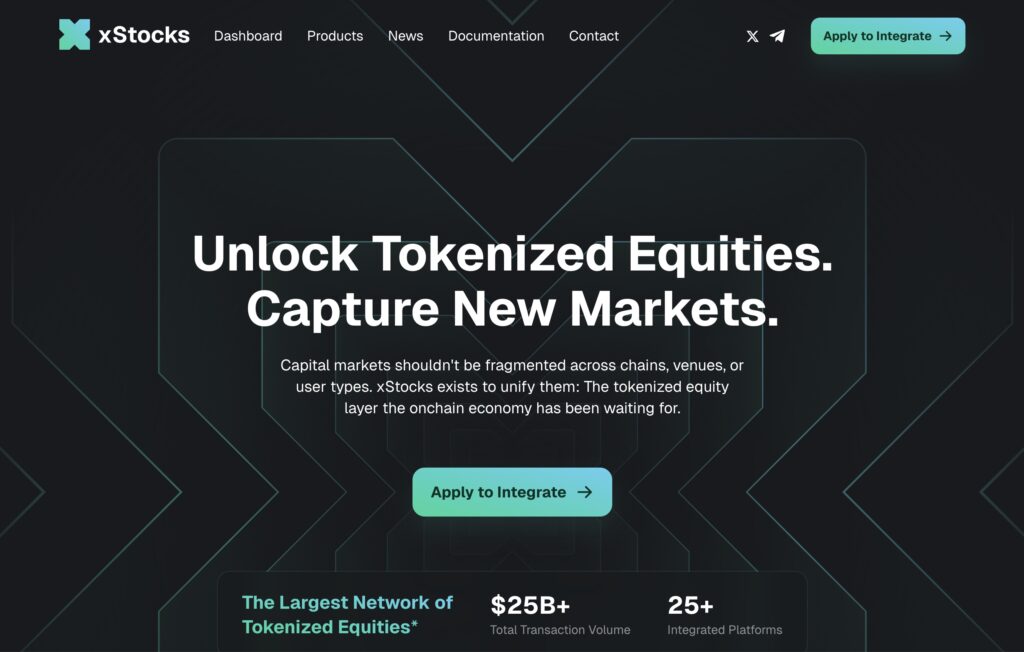
xStocks is developed by Backed Finance AG with a fully collateralized model so that each token is guaranteed 1:1 by real shares held in licensed custodians. xStocks has a proof of reserve that can be transparently viewed by the public through its platform.
Here’s an example of xStocks stock tokenization available on Pintu:
| Token | Underlying | Sector |
|---|---|---|
| CRCLx | Circle Internet Financial | Fintech / Stablecoins |
| TSLAx | Tesla Inc. | Electric Vehicle |
| NVDAx | NVIDIA Corp. | Semiconductors |
| GOOGLx | Alphabet Inc. | Technology |
| AAPLx | Apple Inc. | Technology |
| AMZNx | Amazon.com | E-commerce / Cloud |
Ondo Finance
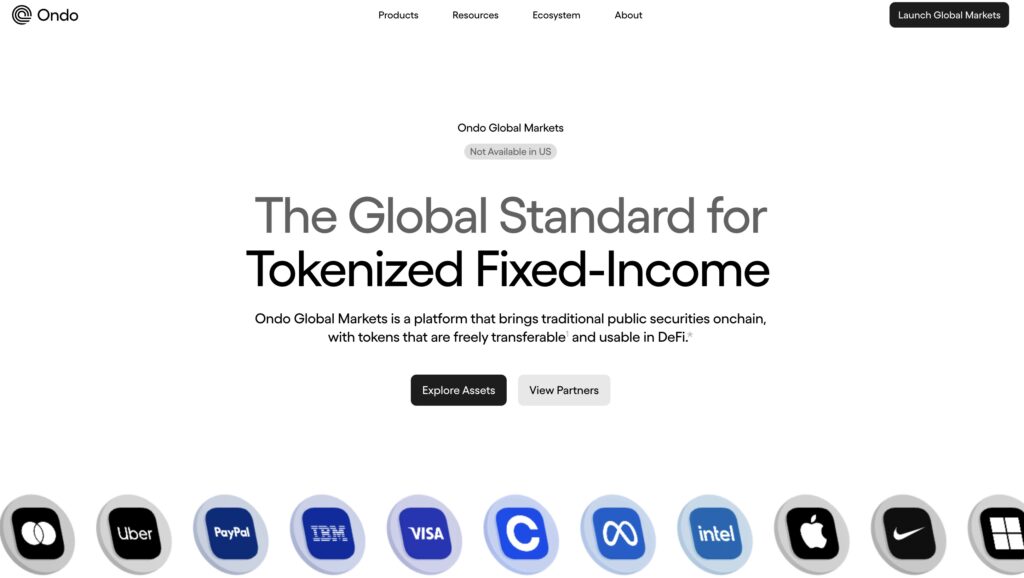
Ondo Finance also has a stock tokenization product called Ondo Global Markets that takes a different approach to stock tokenization. This product from Ondo positions itself as a solution for investors who want a tokenized share price that remains close to the issuer’s price. With this position, the tokenized price of Ondo shares does not deviate too far from the Net Asset Value (NAV).
Here’s an example of Ondo stock tokenization available on Pintu:
| Token | Underlying | Sector |
|---|---|---|
| LLYon | Eli Lilly & Co. | Pharmacy |
| AMDon | Advance Micro Devices | Semiconductors |
| CVXon | Chevron Corp. | Energy |
| BABAon | Alibaba Group | E-commerce |
| PLTRon | Palantir Technologies | AI/Data Analytics |
| MAon | Mastercard Inc. | Payment |
Tax Calculation of Tokenized Shares and Conventional Shares
When an Indonesian investor sells conventional US stocks through an overseas broker, the profit earned is categorized as income. This income is subject to Income Tax Article 17 at progressive rates, ranging from 5% to 35% depending on the total annual taxable income (PKP). There is no automatic withholding tax in this scheme. Investors are responsible for calculating, depositing, and reporting the tax independently through tax returns.
| Annual VAT Layer | Rates |
|---|---|
| Up to Rp60 million | 5% |
| IDR 60 million – IDR 250 million | 15% |
| IDR 250 million – IDR 500 million | 25% |
| IDR 500 million – IDR 5 billion | 30% |
| Above IDR 5 billion | 35% |
In contrast, with stock tokenization, there is a different treatment in terms of taxation. Since the enactment of PMK No. 50 Year 2025 on August 1, 2025, crypto assets including stock tokenization whether issued from xStocks or Ondo are treated as equivalent to securities in the context of taxation by the DGT.
Here are the details of the tax mechanism:
- VAT is removed from crypto asset purchase transactions.
- Tax only applies when selling, in the form of Income Tax Article 22, which is 0.21% of the gross selling value.
How to Calculate US Conventional Stock Tax (Income Tax Article 17)
Income Tax Article 17 uses a progressive system, each layer of taxable income is subject to a different rate gradually, rather than one flat rate for all income. Capital gains from U.S. stocks are aggregated to the total annual taxable income and are subject to graduated rates. There is no automatic deduction, investors are required to calculate, remit, and report on their own in the annual tax return.
Example of Tax Calculation
Capital Gain = Selling Value – Buying Value
Income Tax on Capital Gain = Rate Bracket × Capital Gain
Yola’s profile:
Annual PKP from work (before capital gain) = IDR 200,000,000
NVDA capital gain = Rp3,000,000
Total PKP Yola = Rp200,000,000 + Rp3,000,000 = Rp203,000,000
PKP Yola is in the layer of Rp60 million-Rp250 million, so the entire capital gain of Rp3,000,000 is in the 15% bracket.
Yola buys conventional Nvidia shares worth Rp10,000,000, then sells at a 30% profit.
Income tax = 15% × Rp3,000,000 = Rp450,000 (self-deposit via annual tax return)
Rp 450,000 is the additional tax from capital gains only, not Yola’s total annual income tax. Yola’s total annual income tax is calculated progressively from her entire PKP and is much larger. If Yola’s capital gains are large enough to exceed the IDR 250 million limit, then the portion that exceeds the limit will be subject to a 25% rate.
How to Calculate Stock Tokenization Tax (PMK 50/2025)
Example of Tax Calculation
Final Income Tax = 0.21% x Gross Selling Value
Example:
Yola buys tokenized shares of Nvidia (NVDAx) worth Rp10,000,000, then sells the shares with a 30% profit. The total assets that Yola has after selling are IDR12,972,700.
Income Tax = 0.21% x Rp13,000,000 = Rp27,300
Final Income Tax of 0.21% is included in the sale transaction and is automatically deposited by exchanges such as Pintu if the investor makes a transaction on Pintu and in this case, there is no additional deduction. For SPT reporting purposes, the transaction tax report can be downloaded directly through platforms such as Pintu if investors make transactions on Pintu.
Simulation of Tax Calculation by Issuer
Reference price as of April 1, 2026
| Ticker | Price (USD) | Price (IDR) | Purchase Value | Selling Value | Income Tax on Tokenization of Shares (0.21%) | US Stock Capital Gain Tax (15% Bracket) | Balance Received After Selling (Tokenization of Shares) | Balance Received After Sell (US Shares) |
|---|---|---|---|---|---|---|---|---|
| AAPL | $252,89 | IDR 4,289,520 | IDR10,000,000 | Rp13,000,000 | IDR27,300 | IDR450,000 | IDR 12,972,700 | Rp13,000,000* |
| TSLA | $395 | IDR 6,699,990 | IDR10,000,000 | Rp13,000,000 | IDR27,300 | IDR450,000 | IDR 12,972,700 | Rp13,000,000* |
| PLTR | $150,95 | IDR 2,560,414 | IDR10,000,000 | Rp13,000,000 | IDR27,300 | IDR450,000 | IDR 12,972,700 | Rp13,000,000* |
| LLY | $930,28 | IDR13,830,863 | IDR10,000,000 | Rp13,000,000 | IDR27,300 | IDR450,000 | IDR 12,972,700 | Rp13,000,000* |
*In the simulation of the table above with a 15% bracket, for conventional US stocks, investors must calculate and remit their own income tax of IDR450,000 to the DGT through the Annual Tax Return. That way the net balance received after tax liabilities from US conventional stock investors is IDR 12,550,000. As for stock tokenization, there is no additional deduction because the tax is directly imposed at the time of the sales transaction. This means that investors who conduct stock tokenization transactions can save 16x on taxes.
Comparison of Tokenization of Shares and Conventional Shares A
| Characteristics | Tokenized Stocks | US Conventional Stocks |
| Market Availability | In Pintu stock tokenization transactions can be done 24/7. | Only available during business days and hours. |
| Tax Calculation | Final income tax of 0.21% at the time of sale. | Capital Gain Tax 5%-35% (Income Tax Article 17) |
| Tax Reporting | Automatic tax withholding at the time of sale and easy reporting. | There is no automatic deduction, investors are required to calculate, deposit, and report themselves in the Annual Tax Return. |
| Accessibility | Global and accessible | complex and limited by country-specific regulations. |
How to Buy Tokenized US Stocks on the Pintu App
You can start investing in tokenized stocks like Tesla, Nvidia, Apple, and Palantir right on the Pintu app, the steps are very simple:
- Open the Doors app.
- Go to the Market section and select Tokenized Stocks (TSLAx, AAPLx, NVDAx, LLYon).
- Enter the amount you wish to purchase after logging in.
- You can follow the same steps to buy other tokenized stocks in the Pintu app.
Pintu is also compatible with popular digital wallets such as Phantom and MetaMask, making your transactions even easier. Download Pintu app now on Play Store or App Store! Your safety is guaranteed, as Pintu is supervised by OJK (Financial Services Authority) and CFX.
In addition to trading, Pintu also allows you to learn more about crypto through various educational articles on Pintu Academy which are updated weekly. All articles published on Pintu Academy are for educational purposes only and are not financial advice.
Conclusion
For both xStocks and Ondo, the stock tokenization tax applicable to investors in Indonesia remains the same at around 0.21%. Stock tokenization is not just a trend, but a new infrastructure that is changing the way investors access global equity markets. Its advantages are not only in lower tax rates, but also in 24/7 transaction flexibility, fractional ownership, and ease of access for investors.
References
- Eko Priyono, “PMK 50/2025 and Fiscal Kaizen: A New Path for Equitable Crypto Tax“, DJP, accessed on March 17, 2026.
- Didik Yandiawan, “PMK 50/2025: A New Chapter of Crypto Asset Taxation” DJP, accessed on March 17, 2026.
- “How is the Reporting and Payment Mechanism of Foreign Stock Tax?“, Pajakku, accessed on March 17, 2026.
- “What is the Legal Basis and Latest Regulation of Foreign Stock Sales?“, Pajakku, accessed on March 17, 2026.
- “Income Tax Article 4 paragraph (2)“, DJP, accessed on March 17, 2026.
- C, “Tokenized Stocks: What’s The Point?“, Arkham, accessed on March 17, 2026.
- “xStocks Documentation“, xStocks, accessed March 17, 2026.
- “Ondo Finance Documentation“, Ondo, accessed on March 17, 2026.