Tokenized stocks are gaining attention as they present a new way to gain exposure to global stocks through blockchain technology. One example is the Microsoft Tokenized Stock or MSFTon, which is a token designed to represent Microsoft shares in the form of an on-chain digital asset. So, what is MSFTon and how does it work? Check out the full story!
Article Summary:
- ⛓️ MSFTon is a blockchain-based asset that represents Microsoft shares.
- 🪞 MSFTon is designed to track the total return of Microsoft (MSFT) stock.
- 🧳 Unlike traditional MSFT shares, MSFTon can be moved between crypto wallets.
- 💰 As of April 7, 2026, Microsoft’s market capitalization was around $2.75 trillion.
What is Microsoft Tokenized Stock (Ondo)?
Ondo ‘ s Microsoft tokenized stock with the ticker MSFTon is a blockchain-based asset that represents shares of Microsoft Corporation in token form. The token is issued by Ondo Global Markets and is designed to be fully backed by genuine Microsoft shares held by custodians within Ondo’s Global Markets structure.
As such, MSFTon holders can gain economic exposure similar to owning MSFT stock directly, including the benefit of dividends that are automatically reinvested. The value of each token also tracks the total return of Microsoft stock, so its movements reflect the long-term performance of the company.
Different from regular Microsoft shares that are traded on NASDAQ through traditional brokers, MSFTon is traded on public blockchains and crypto exchanges. In its mechanism, Ondo holds genuine Microsoft shares through a regulated custodian, and then issues tokens reflecting the value of those shares to eligible non-US investors.
Through this scheme, investors can gain economic exposure equivalent to owning MSFT shares along with directly reinvested dividends, with trading access for 24 hours a day, 5 days a week, as well as direct connection to traditional US stock market liquidity.
How does MSFTon Asset Tokenization Work?
MSFTon works with the general mechanism of Ondo’s tokenized stocks. Simply put, the token is designed to track the total return of Microsoft (MSFT) stock and is fully backed by the underlying stock that is stored off-chain.
1. Asset Collateral and Custody
Ondo’s specialized entity purchases and holds Microsoft shares in a brokerage account through a regulated custodian. MSFTon tokens are then issued to represent exposure to those shares, including the effect of reinvested dividends after taxes.
Token holders do not have direct legal ownership rights to MSFT stock, but still gain economic exposure designed to be equivalent to a strategy of “owning MSFT stock and reinvesting its dividends” over a period of time.
2. Minting and Redemption Process
Eligible non-US users can mint MSFTon by depositing stablecoins or cash funds into the Ondo Global Markets platform. The funds are then used to purchase MSFT shares, the underlying asset, and tokens are issued to users.
Conversely, tokens can also be exchanged back into stablecoins or cash based on NAV at trading hours, with Ondo forwarding orders to the traditional US stock market. In addition, MSFTon tokens can also be traded separately on secondary markets and other supporting platforms.
3. Price and Liquidity Tracking
The price of the MSFTon follows the price of the Microsoft stock which is its underlying asset through the following mechanisms:
- Real-time MSFT price from traditional exchanges.
- Ondo’s RFQ and market making system.
- On-chain liquidity on the Ethereum network and BNB Chain, as well as order books on centralized and decentralized exchanges.
Since the minting and redemption process is designed to be fast and minimal, arbitrage can help keep the MSFTon price close to the MSFT stock price. This mechanism also reduces the potential for high spreads that were previously common in early generation tokenized stock experiments.
Then, is MSFTon backed by genuine Microsoft shares? Yes, MSFTon is backed by genuine Microsoft shares purchased and held by entities within the Ondo ecosystem through regulated custodians.
While backed by genuine Microsoft shares, there is an important distinction to be made. What is backed by genuine shares is the token economy, not that MSFTon holders own those Microsoft shares directly in their personal name.
Difference between MSFTon and Microsoft Stock (MSFT)
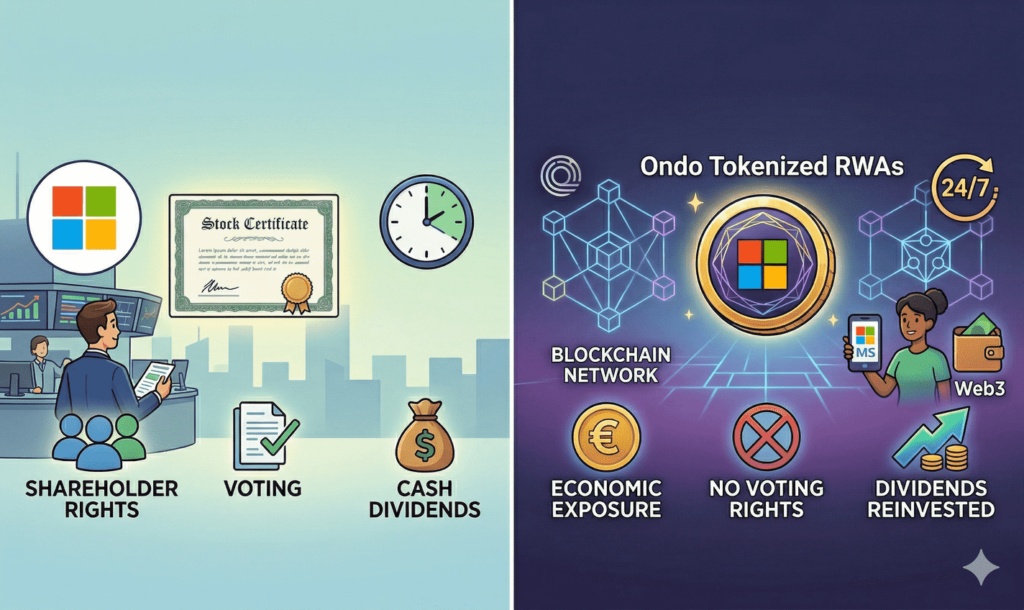
While the MSFTon is designed to track Microsoft’s share price and earn dividends that are reinvested back into the asset, the instrument remains distinct from owning Microsoft shares directly. MSFTon serves as an on-chain representation designed to provide flexibility in trading activities and portfolio diversification. With this model, users can combine Microsoft holdings with other cryptocurrencies and tokenized assets on a single platform. However, MSFTon owners do not have the traditional rights of shareholders.
Some of the differences are as follows:
No shareholder rights
MSFTon holders do not have voting rights, do not receive dividends directly from Microsoft, and do not receive official company communications like ordinary shareholders.
Tokenized, not listed shares
When owning MSFTon, what is owned are tokens on the blockchain, not Microsoft shares registered in the investor’s name in a brokerage account.
Subject to different jurisdictions and rules
MSFTons are generally not available to US citizens and are offered under a different regulatory framework than retail brokerage accounts in the United States stock market.
Can be used in the DeFi ecosystem
Different from traditional MSFT shares, MSFTon can be moved using crypto wallets, used in DeFi protocols, or combined with other on-chain strategies across various on-chain platforms .
MSFTon Advantages for Crypto Investors
Here are some of the advantages of MSFTon for crypto investors:
1. Opens up liquidity and creates a secondary market
One of the biggest advantages of stock asset tokenization is its ability to open up access to assets that are usually difficult to own. Through tokenization, assets that were previously difficult to trade can be turned into digital units that are more liquid and easily tradable.
With this model, asset owners do not have to sell all of their assets to raise funds, but can simply offload a portion of ownership in the form of tokens. Some important aspects of increasing liquidity through tokenization include:
- Establishment of a secondary market
After the initial offering is made, the tokens can be freely traded on secondary markets, including on decentralized exchanges (DEX).
- Attract a broader investor base
The presence of a liquid secondary market makes it easier for asset issuers to reach a wider range of investors, especially those who value flexibility in trading their investments. In addition, many investors who cannot access the US stock market can now buy shares of companies like Microsoft.
2. Lower costs and faster transaction completion
Asset tokenization like MSFTon leverages blockchain technology and smart contracts to simplify the process. Smart contracts are becoming a key foundation in tokenization systems as they are able to replace many manual processes. This automation brings a number of important improvements, including:
- Reduced barriers and reliance on intermediaries
By automating processes such as compliance checks, dividend payments and ownership transfers, smart contracts can reduce the need for intermediaries. As a result, transaction costs are lowered and previously slow processes are accelerated.
- Near-instant transaction settlement
In traditional markets, transaction settlements generally follow a T+2 cycle, which means new transactions are actually completed within a few days. In a tokenized system, assets can be settled in near real-time, so this risk is reduced and the efficiency of capital utilization is increased.
- Simpler asset management
Smart contracts allow revenue distributions to be made automatically to token holders, for example rental income from tokenized properties or interest payments from tokenized bonds.
3. Fractional ownership and broader market access
Tokenization changes the concept of fractional ownership, dividing high-value assets into smaller, more affordable and tradable units. Some of its key advantages are:
- Lowering entry barriers
By dividing asset ownership into small fractions, tokenization allows individuals to invest in assets that were previously out of reach. For example, investors don’t need to put up millions of dollars, but can simply buy tokens that represent a fraction of a particular asset, even starting at $1.
- Reaching out to global investors
Blockchain networks are inherently borderless. This allows asset issuers to reach investors from different countries without having to deal with the complexities of cross-border financial systems as with traditional mechanisms.
Risks of Buying Microsoft Tokenized Stocks
Despite offering many advantages, Microsoft’s tokenized stocks still have a number of risks that need to be considered. As a relatively new technology, its security challenges generally come from three main aspects: technology risk, market risk, and regulatory risk.
Technology Risk
While smart contracts make the process more efficient, weaknesses in the code can still be exploited by hackers and potentially lead to asset loss. Additionally, disruptions to the security or stability of the blockchain network can also affect the overall functionality of the token.
Another risk comes from the failure of the oracle, the system that provides real-time price data. If the oracle doesn’t work properly, the token price could deviate from the original share price.
Market Risk
As the stock asset tokenization market is still at an early stage of development, many platforms have relatively low liquidity. This can be problematic when markets are highly volatile or when trading activity declines. In such situations, the difference between the buy and sell price can widen, and at certain times transactions can become difficult or temporarily impossible.
Regulatory Risk
The legal framework for tokenized stocks is still evolving in different countries, and the regulatory approach is not uniform. This uncertainty creates additional risks for investors.
Authorities such as the European Securities and Markets Authority (ESMA) have warned that some tokenized stocks may not provide true shareholder rights, such as voting rights, potentially leading to misunderstandings for investors.
Things to Consider Before Investing in MSFTon
When dealing with a new instrument, the most appropriate attitude is to remain open to learning, but also cautious. Here are things to consider:
Issuer and custodian verification
Find out which company is issuing the token and learn about its background and reputation. Last but not least, make sure to find out which regulated financial institution is in charge of holding the real shares that are claimed to be the underlying assets of the token.
Check the asset support model
Check if the token is actually pegged 1:1 to the underlying stock. Some products may simply take the form of derivative contracts that mimic stock price movements, without actually having an underlying stock backing them.
Technical safety aspect score
Prioritize tokens issued on large, proven blockchains. Also, check the security track record of the platform on which the token is traded, including how it protects users’ assets.
Pay attention to liquidity and spreads
Before making a transaction, observe the token’s trading volume and the difference between the buy price and sell price.
Microsoft Stock Performance
After getting to know more about MSFTon, the next question that may arise is whether MSFTon is suitable for the long term. To help answer that, one thing to look at is how Microsoft stock as the underlying asset is performing.
Microsoft Market Capitalization Growth (1996-2026)
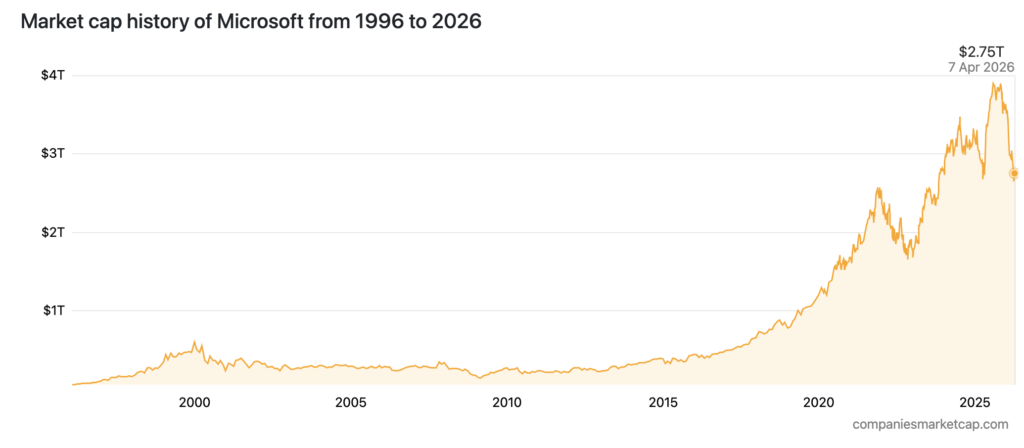
The chart above shows that Microsoft’s market capitalization experienced very strong long-term growth from 1996 to 2026, although the journey was not always smooth. In the late 1990s, Microsoft’s valuation rose sharply, then reached an initial peak around the 1999-2000 period. After that, the value underwent a considerable correction and moved relatively flat for a long time throughout the decade from the 2000s to the early 2010s.
The truly aggressive growth phase of Microsoft’s market capitalization began after the mid-2015s. Since that period, Microsoft’s market capitalization increased consistently and then accelerated very quickly towards the 2020s, reaching a level of more than $2 trillion until 2025 when it reached a level of $3.9 trillion.
Overall, the most recent data point on the chart shows that on April 7, 2026, Microsoft’s market capitalization was around $2.75 trillion, a decline from its highest level.
Microsoft Revenue Trends (1996-2025)
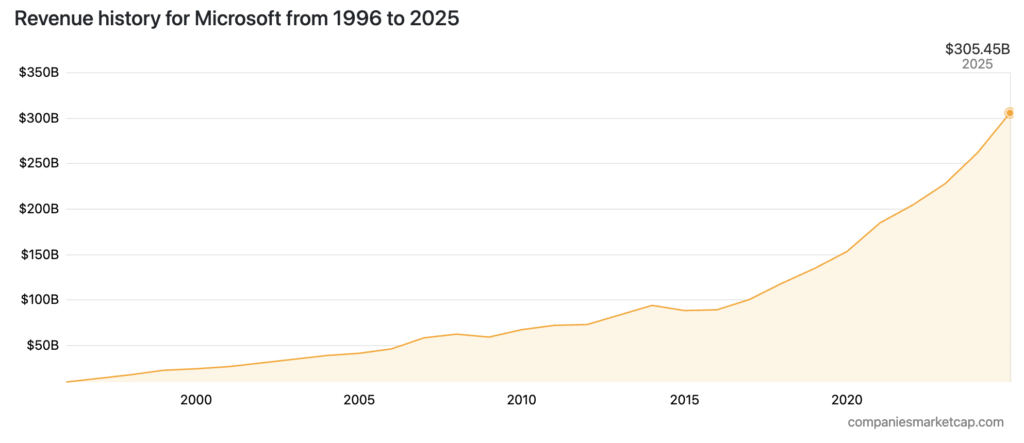
The revenue chart above shows that Microsoft’s revenue has grown very strongly over the long term, from a relatively small level in the late 1990s to around $305.45 billion in 2025.
From 1996 to the mid-2000s, the increase in revenue was steady. Then, the graph shows some weakening points, especially around the late 2000s and mid-2010s, before resuming the upward trend.
The most notable changes are seen from the late 2010s to 2025. In this period, the revenue curve becomes much steeper, signaling faster growth acceleration compared to the previous decade. If around 2017 revenues were still below $100 billion, then in the next few years Microsoft managed to surpass $150 billion, then $200 billion, and finally break over $300 billion in 2025.
Microsoft P/S Ratio 2001 – 2025
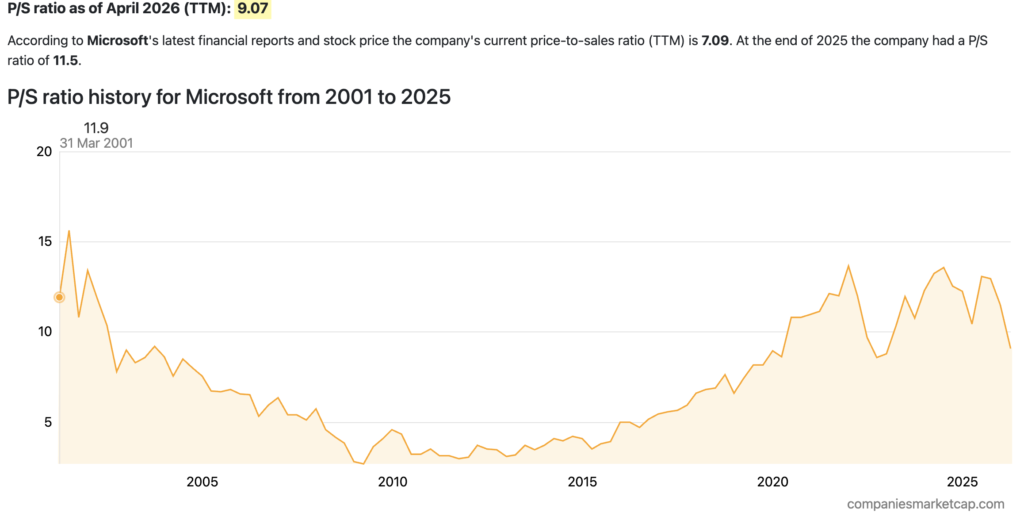
The chart shows that Microsoft’s valuation based on price-to-sales ratio (P/S) underwent considerable changes in the period from 2001 to 2025. The starting point marked on March 31, 2001 shows a figure of around 11.9, indicating that the market at that time valued Microsoft stock at almost 12 times its earnings.
After that, Microsoft’s P/S ratio tended to decline gradually throughout the decade of the 2000s. This decline lasted for quite some time until it reached its lowest point around 2009-2011, when the P/S moved in the range of 3 to 4.
In the mid-2010s, the trend began to change. Microsoft’s P/S ratio increased consistently again. This increase became more pronounced from around 2018 and continued into the early 2020s, when the P/S was in the range of 10 to above 13.
At the end of the chart, Microsoft’s P/S ratio appears to be declining again compared to previous peaks. Available data shows the latest figure at around 9.07 for April 2026, while information on the CompaniesMarketCap page mentions 7.09 as the current P/S (TTM).
How to Buy Microsoft Tokenized Stock on Pintu
On Pintu, the purchase of Microsoft tokenized stock (MSFTon) can start at a very affordable amount of Rp11,000, allowing users to gain exposure to Microsoft’s valuation without a lot of capital.
In addition to MSFTon, Pintu also provides various other tokenized stocks such as TSLAX, MAon, and other similar assets through its Market Tokenized Stocks page, allowing users to easily access a variety of global stocks in on-chain form.
Here’s how to buy Microsoft Tokenized Stock (MSFTon) on Pintu:
- Enter the Pintu homepage.
- Go to the Market page.
- Search and select the MSFTon crypto asset.
- Enter the amount you wish to purchase, and follow the rest of the steps.
Conclusion
Overall, MSFTon can be understood as a tokenized stock designed to provide economic exposure to Microsoft shares in an on-chain format. This instrument is interesting because it combines the characteristics of traditional stocks with the flexibility of the blockchain ecosystem, ranging from more flexible trading access, potential integration with other digital assets, to the possibility of utilization in DeFi infrastructure. In this context, MSFTon is not just a representation of Microsoft’s share price, but also a new form of more modern and efficient investment access.
Disclaimer: All articles from Pintu Academy are intended for educational purposes and do not constitute financial advice.
Reference:
- BingX. What Is Ondo’s Microsoft Tokenized Stock (MSFTON) and How to Buy It? Accessed on April 8, 2026
- Gregg Pascal Zachary, Mark Hall, Karl Montevirgen. Microsoft Corporation. Accessed on April 8, 2026
- OSL. Are Tokenized Stocks Safe? The Risks You Need to Understand. Accessed on April 8, 2026
- XBTO. 7 key benefits of tokenizing real-world assets. Accessed on April 8, 2026
