
Amid global economic uncertainty, investors often seek assets that can provide protection against market volatility, inflation and geopolitical turmoil. These assets, known as safe havens, have the ability to maintain or even increase their value when markets are at risk. Some prime examples of safe haven assets include gold, the US dollar, and government bonds. In this article, we will discuss what safe havens are, examples of assets, diversification strategies amid economic uncertainty, and the impact of geopolitics on these assets.
Article Summary
- 🟡 Gold as a Safe Haven: Gold has risen more than 200% this decade, often considered a hedge in times of market turmoil.
- 💵 US Dollar & Swiss Franc: USD and CHF serve as major safe havens, with USD strengthening during geopolitical tensions and CHF maintaining political stability.
- 📉 Government Bonds (US Treasuries): While government bonds are often considered safe, inflation and fiscal policy factors can affect their attractiveness.
- 💻 Bitcoin as “Digital Gold”: Bitcoin shows high growth potential, but its extreme volatility makes it less stable as a safe haven than traditional assets.
- 🛡️ Portfolio Diversification: Combining multiple safe haven assets, such as gold, strong currencies, and government bonds, helps reduce risk in an investment portfolio.
What is a Safe Haven?
Safe havens are assets that tend to maintain or even increase in value when markets experience uncertainty, such as recession or inflation. These assets help reduce risk in an investment portfolio as they are not directly correlated with the stock market. Common examples of safe havens are gold, high-quality government bonds and strong currencies. These types of investments provide protection against declines in the value of other risky assets.
In investment strategies, safe havens are important for diversification and managing risk amid market volatility. Safe haven selection depends on liquidity, credit risk and sensitivity to economic conditions. These assets serve as hedges, reducing losses when markets are volatile. A good understanding of safe havens allows investors to make wiser decisions in the face of uncertainty.
4 Examples of Safe Haven Assets
Here is a list of examples of major safe haven assets:
1. Gold/Precious Metals
Gold as a safe haven is one of the most classic examples in the history of global financial markets. As a precious metal with a high intrinsic value, gold tends to maintain or even increase its value in times of economic turmoil, high inflation, or geopolitical uncertainty.
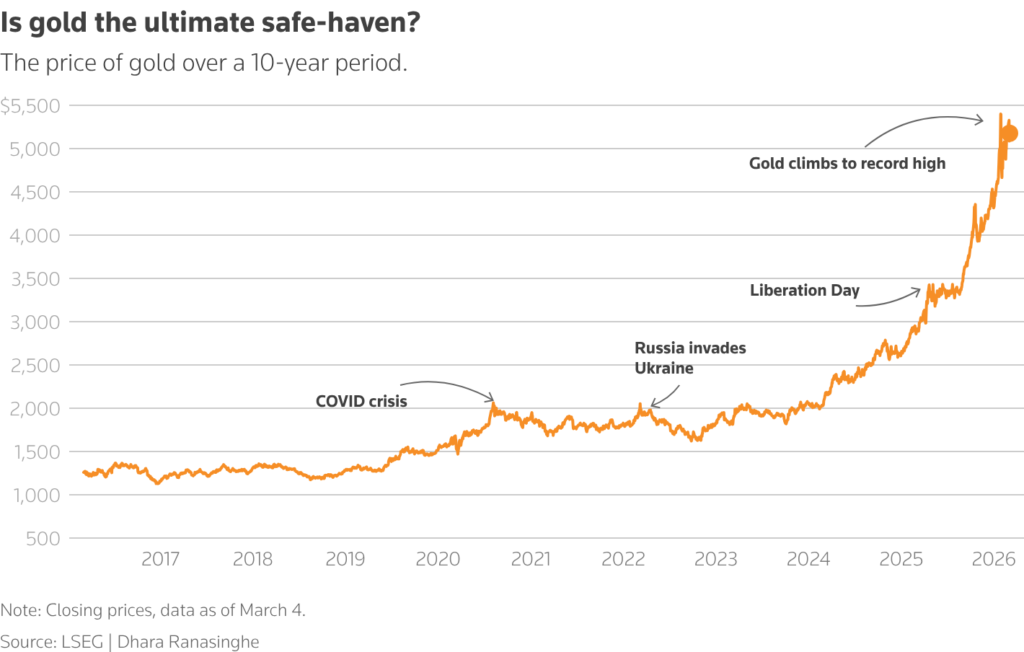
Gold prices have risen more than 200% this decade, driven by fears of inflation and global market instability. This confirms gold’s role as a hedging instrument against stock market declines or currency depreciation. Despite this, gold allocations in global investment portfolios are still relatively low, with many analysts suggesting allocations of around 5-10% for risk diversification, as reported by Reuters.
Gold has a steady demand from institutional investors and central banks, especially during economic uncertainty. In situations such as geopolitical conflicts or economic slowdowns, gold serves as a store-of-value. Gold tends to have a low or negative correlation to global equity markets, making it a safe investment choice. The trend of central banks purchasing gold for reserve diversification further emphasizes its role as a hedging instrument of global uncertainty.
2. Government Bonds (US Treasuries)
Government bonds from countries with high credit ratings, such as U.S. Treasuries, are a prime example of a safe haven in global investing. During periods of stock market turmoil or economic instability, investors tend to turn to these bonds as safer assets. Demand for Treasuries usually increases when there is risk-off sentiment in the market. This causes bond prices to rise and yields to decline, reflecting the perceived safety of these instruments.
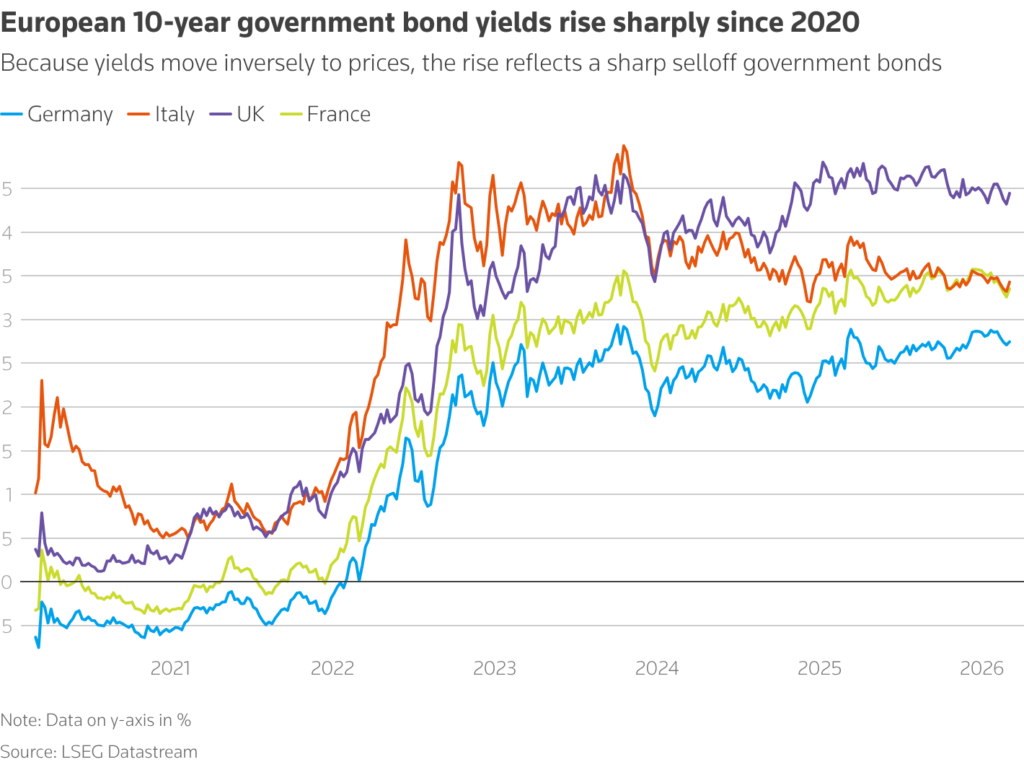
According to the latest data from LSEG Datastream cited by Reuters, government bonds have struggled to attract the safe investment flows typically seen during geopolitical shocks. Investors are focusing more on the inflation outlook rather than the defensive nature of the bonds.
In addition, fiscal considerations, such as the easing of Germany’s debt rules, and concerns regarding the increase in government debt, outweigh its appeal as a safe haven. Yields on German 10-year bonds (Bunds), the Eurozone benchmark, have jumped 14 basis points recently.
The chart shows a sharp spike in European government bond yields since 2020, reflecting a sharp decline in bond prices. Although Germany is considered a safe investment, the rise in higher debt reduces the attractiveness of long-term bonds as a refuge in volatile markets.
3. Specific Global Currencies
Some major global currencies, such as the United States Dollar (USD), Swiss Franc (CHF) and Japanese Yen (JPY), serve as safe havens in times of economic uncertainty or market turmoil. These currencies are considered safe due to their economic stability, high liquidity, and investor confidence in the financial system of the issuing country.
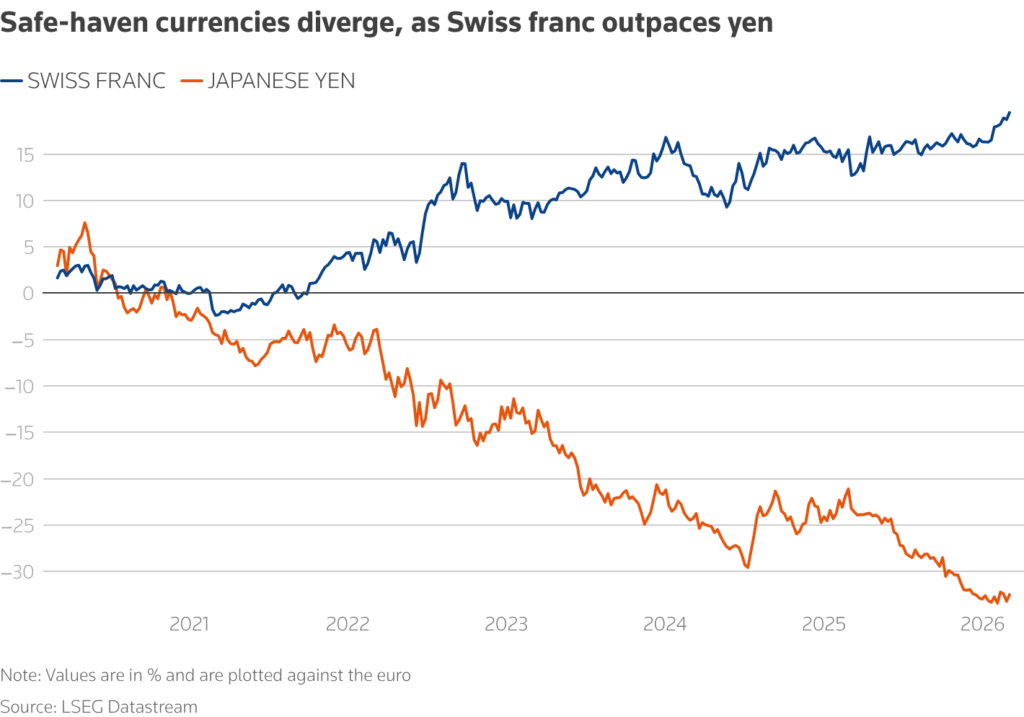
According to the latest data from LSEG Datastream cited by Reuters, the Swiss Franc and the Japanese Yen had fallen 1.2% and 0.8% recently. Although the Yen looks more attractive in terms of valuation, political uncertainty in Japan, regarding plans to raise interest rates, adds risks to the Yen’s prospects.
On the other hand, the Swiss Franc’s strength was limited by warnings from the Swiss National Bank (SNB) that it is ready to intervene to prevent excessive strengthening. The chart above shows divergence, with the Swiss Franc strengthening more significantly than the Yen since 2023.
The role of strong currencies as safe havens also relates to crisis response. When there are global concerns such as financial crises or geopolitical conflicts, demand for currencies such as the USD increases as investors accumulate liquidity in strong currencies to hedge their portfolios. The Swiss Franc and Yen also exhibit safe haven strength due to their stable financial systems and trade surpluses that support their economic fundamentals, respectively.
4. Bitcoin
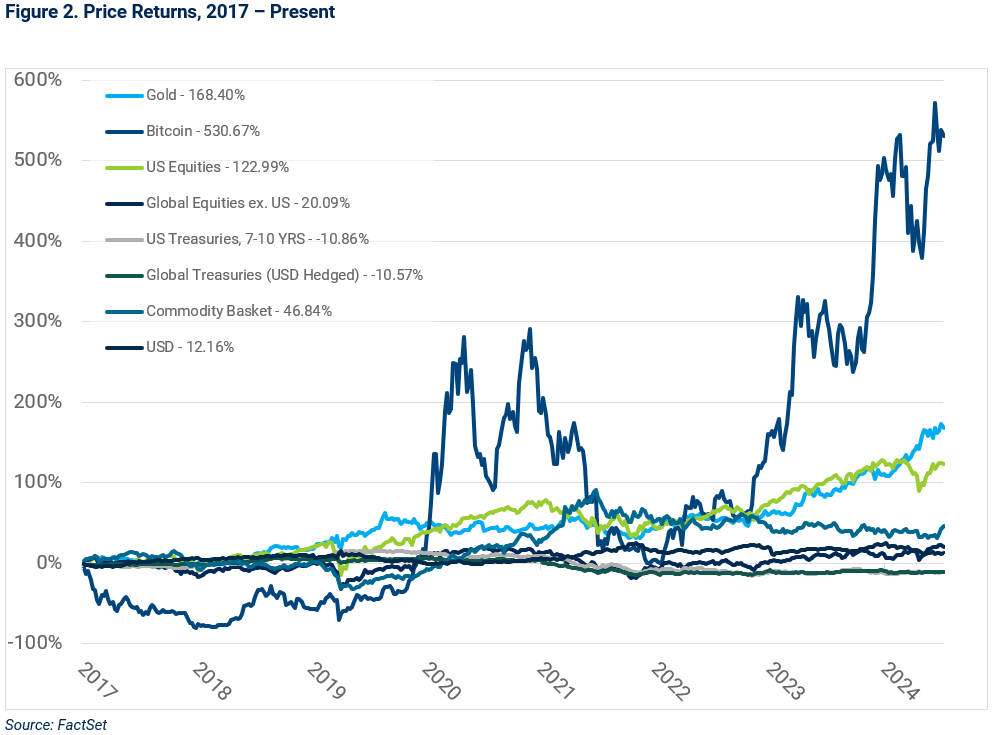
The chart above shows a comparison of the price performance of Bitcoin, gold, and other assets, with Bitcoin showing a sharp rise compared to other instruments. Bitcoin is often referred to as “digital gold” because its price has risen significantly in recent years, but with extreme volatility. Since its inception, Bitcoin’s price has risen by more than 530%, far outpacing gold’s rise of only about 168% over the same period.
Nonetheless, Bitcoin’s high price volatility often fluctuates sharply over short periods of time, in contrast to gold’s stability. Bitcoin has shown a relatively low correlation with gold, averaging only 0.14, since it launched futures trading in late 2017.
As a speculative asset and alternative to cryptocurrency technology, Bitcoin has appealed to investors looking for an asset that is not directly linked to traditional markets and offers high growth potential. While some consider Bitcoin a hedge like gold, its high volatility makes it more suitable as a high-risk investment tool than as a safe haven.
How to Choose a Safe Haven?
- Correlation with the Market Choose assets that have a low or negative correlation to the stock market. Assets that behave differently to the stock market or other risky markets will provide better protection during periods of volatility.
- High Liquidity An effective safe haven asset should have high liquidity. This allows investors to buy or sell the asset easily without significantly affecting the market price.
- Value Stability Choose assets with a proven history of stability, such as gold or high-quality government bonds, that have held their value during periods of crisis.
- Diversify Risk Don’t rely on just one type of safe haven asset. Diversify your portfolio with several types of safe havens (such as gold, strong currencies, or government bonds) to reduce overly concentrated risk.
- Ability to Counter Inflation Assets that can hedge against inflation are a better choice. Gold, for example, is often used to hedge against inflation and declining currency purchasing power.
- Macroeconomic Considerations Consider macroeconomic conditions when choosing a safe haven, including monetary policy, interest rates, and potential fiscal policy changes that could affect the asset’s performance.
- Geopolitical Conditions A good safe haven asset should also take into account geopolitical factors. Assets like the US Dollar or Swiss Franc are often considered safer in times of political uncertainty or international crisis.
- Government or Institutional Back ing Choose assets backed by strong governments or international institutions, such as developed country government bonds that have high credit ratings, which tend to be more stable in difficult times.
Diversification Strategy during Geopolitical Tensions
Here is a complete guide to portfolio diversification strategies to preserve the value of your assets amid high volatility:
1. Re-allocation to New Generation “Safe Haven”
As systemic risk increases, global investors tend to turn to assets that have strong intrinsic value.
- Gold as the Main Anchor: Until March 12, 2026, the world gold price remained at historical levels of around $5,150 – $5,175 per troy ounce. Gold currently serves as a stagflation hedge as it is able to counter currency devaluation due to rising energy costs.
- US Dollar & Swiss Franc: USD remains the main beneficiary of the flight to safety. On the other hand, Swiss Franc (CHF) and positions in Singapore remain options for neutral geographical diversification.
2. Focus on Defense Sector & Strategic Independence
Geopolitics 2026 is not only about war, but also about technological mastery and national security.
- Defense Stocks: Companies like Lockheed Martin (LMT) or Teledyne (TDY) are options as global military budgets continue to rise.
- AI Technology as Defense: Microsoft (MSFT) is now seen as a “Growth-Defense” as their AI tools are increasingly integrated into national security systems and corporate critical infrastructure.
- Energy & Commodities: With Brent oil prices hovering around $87 per barrel (rising due to the conflict in the Strait of Hormuz), energy and commodity sector stocks (such as coal and metals) provide a natural hedge against inflation.
3. Fixed Income Strategy: “Underweight Duration”
Under current conditions, holding long-term bonds is very risky as inflation driven by energy prices may force central banks to delay rate cuts.
- Short Tenor Bonds: Analysts suggest focusing on short tenor bonds (1-3 years) to maintain liquidity and reduce the risk of price fluctuations due to sudden interest rate changes.
- Money Market Mutual Funds: Maintaining a larger portion of cash or money market mutual funds (around 15-20% of the portfolio) is crucial as “ammunition” to buy on weakness when the stock and crypto markets experience a sharp correction.
4. Geographical Diversification: Seeking Stable Markets
Avoid concentration of assets in areas of direct conflict.
- Resilient Emerging Markets: Indonesia remains attractive due to strong economic fundamentals, but investors need to be selective on blue chip stocks that have export exposure to neutral countries.
- Europe vs US: Some fund managers (such as Allianz GI) are starting to look at the European market which has cheaper valuations and broader sector diversification than the US market which is heavily concentrated in tech giants.
Read about Bluechip Stocks vs Fried Stocks at Pintu Academy!
5. Psychological Discipline: Avoid FOMO & Panic Selling
Historical data shows that markets tend to recover within 1-12 months after the initial geopolitical shock.
- Corrections are Opportunities: Don’t get caught up in panic selling. If the company’s fundamentals remain sound, a price drop due to war sentiment is often the best entry point.
- Data Verification: In the disinformation era of 2026, make sure every investment decision is based on financial statement data, not just provocative social media headlines.
Key Data Summary (March 2026):
| Asset / Indicator | Position/Price (Estimated) | Recommendation |
|---|---|---|
| Gold (XAU) | $5.153/oz | Overweight (Main Hedge) |
| Oil (Brent) | $87/barrel | Watchlist (Monitor Inflation) |
| JCI (Indonesia) | Volatile (Energy Support) | Selective (Energy/Staples stocks) |
| Cash / Money Market | 15% – 20% Portfolio | Liquid (Ready to Buy on Correction) |
Geopolitical Impact on Safe Haven Assets
Until mid-March 2026, the power map of safe haven assets experienced a drastic shift due to the escalation of conflict in the Middle East involving direct tensions between the US-Israel and Iran, as well as the effective closure of the Strait of Hormuz. These conditions triggered a very aggressive flight to quality phenomenon.
Flight to quality is the reflex movement of investors to "save themselves" by moving capital from high-risk assets to much safer and more stable assets.
Here is how geopolitics impact safe haven assets:
1. Gold (XAU): The King in the Midst of Crisis
Gold confirms its status as the ultimate hedge asset. Throughout early 2026, the world gold price set a new historical record.

- Recent Data: Gold touched an all-time high of $5,400 per troy ounce in late January 2026, before correcting slightly to a range of $5,100 – $5,150 in March 2026.
- Cause: The closure of the Strait of Hormuz led to fears of global stagflation (high inflation due to oil prices, but slowing economy). In addition, the halt in the discovery of new gold reserves during 2024-2025 makes the supply side very limited, so prices continue to be pushed up.
2. US Dollar (DXY): Liquidity Dominance
Although there is a long-term dedollarization trend, in the short term, the USD remains a liquidity magnet when there is an open war.
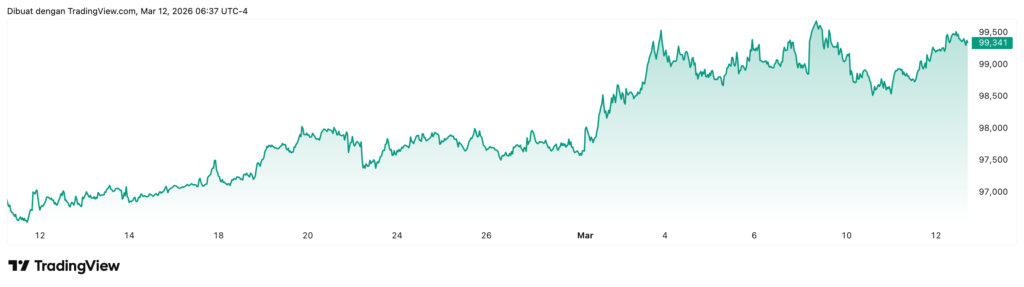
- Latest Data: The Dollar Index (DXY) gained about 1.5% in just the first week of March 2026.
- Impact: The strengthening of the USD is putting double pressure onEmerging Markets, as the cost of servicing external debt increases at a time when the price of imported commodities (such as oil) is also soaring.
3. Swiss Franc (CHF): Fortress of Neutrality
The Swiss franc is making a comeback due to its safe location from conflict centers and political stability.
- Latest Data: CHF is trading at around 0.77 – 0.78 per USD. This is a very strong position historically.
- SNB Intervention: The Swiss National Bank (SNB) has reportedly started preparing for market intervention as the overvalued Franc is starting to threaten the competitiveness of their exports and the risk of domestic deflation.
4. Government Bonds (US Treasuries)
Traditionally, investors buy bonds in times of war. However, in 2026, the dynamics are more complex.
- Phenomena: Despite capital inflows into the bond market, rising oil prices near $120 per barrel triggered high inflation expectations. This caused bondyields to remain high (volatile) as investors feared that the central bank would not cut interest rates in the near future.
5. Bitcoin (BTC): The “Digital Gold” That’s Still Being Tested
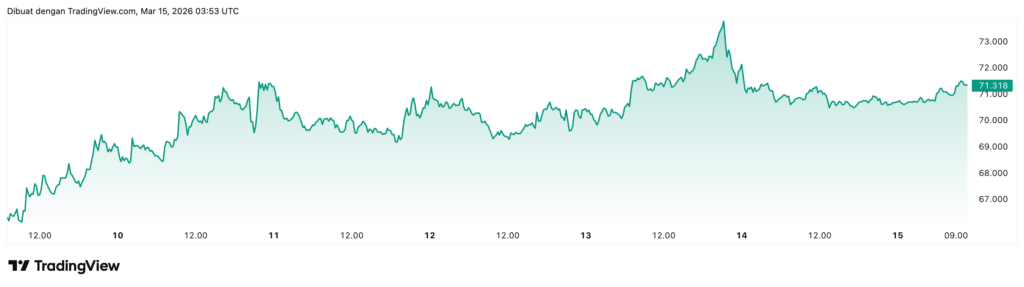
Bitcoin’s status as a safe haven is still hotly debated in 2026.
- Performance: Despite its initial decline, Bitcoin has been on the rise since early March amid the Iran conflict. Bitcoin continues to show higher correlation with risk assets (such as tech stocks).
- Analysis: Bitcoin is still considered a long-term store of value, but in the acute “military panic” phase, institutions prefer physical liquidity (gold and cash) over digital assets, so there is still little liquidity coming into BTC.
Asset Performance Comparison (Update March 2026)
| Assets | Status 2026 | Key Sentiments |
|---|---|---|
| Gold | Strong Bullish | Supply shortages & risk of nuclear/regional war. |
| US Dollar | Bullish | Emergency global liquidity needs. |
| Swiss Franc | Strong Bullish | Capital flight from European & Middle Eastern conflict zones. |
| Bitcoin | Neutral/Volatile | Still moving in line with global risk sentiment. |
| Brent Oil | Extremely Bullish | Disruption of the Strait of Hormuz & energy supply lines. |
How to Buy Gold-Based Crypto at the Pintu?
At Pintu, the purchase of gold-based cryptos such as Pax Gold (PAXG) and Tether Gold (XAUT) can start with as little as Rp11,000, allowing users to gain exposure to Gold valuations without a large capital outlay.
Here’s how to easily buy PAXG and XAUT at the Pintu:
- Enter the Pintu homepage.
- Go to the Market page .
- Search and select the crypto asset PAXG or XAUT
- Enter the amount you wish to purchase, and follow the rest of the steps.
Conclusion
In times of global geopolitical and economic uncertainty, the choice of safe haven assets such as gold, government bonds, strong currencies, and Bitcoin becomes important to maintain portfolio stability. Gold remains a top choice with solid performance during periods of volatility, while the USD and Swiss Franc demonstrate high liquidity strength and political stability.
While Bitcoin offers high growth potential, its volatility makes it less stable as a safe haven compared to traditional assets. Diversification by utilizing different types of safe havens and considering geopolitical factors and macroeconomic conditions can help investors manage risk in an uncertain market.
Disclaimer: All articles from Pintu Academy are intended for educational purposes and do not constitute financial advice.
Reference:
- Investopedia. What Are Safe Haven Investments? Definition and Key Examples in Investing. Accessed March 15, 2026
- Pawnshop Friends. What is Safe Haven? Let’s recognize the types and benefits. Accessed on March 15, 2026
- Reuters. Dollars, bonds or gold – which is the safest haven to hold? Accessed March 15, 2026
- Factset Insight. Metals & Mining: Looking for a Safe-Haven Asset? Accessed March 15, 2026