
Amazon Tokenized Stock (AMZNX) is a tokenized asset that represents Amazon’s stock price. As of April 2026, according to Companiesmarketcap, Amazon is one of the largest public companies in the world with a market capitalization of approximately $2.375 trillion. With asset tokenization technology, investors can now have stock assets in their crypto portfolio. This article will discuss how AMZNX works, how AMZN stock performs as an underlying asset, and how it differs from regular Amazon stock!
Article Summary
- 📈 AMZNX is a blockchain-based tokenized stock that gives exposure to Amazon’s stock price movements without having to buy the shares directly on the exchange.
- 🏢 Amazon has a diversified business, with major revenue coming from Online Stores, Third-Party Seller Services, and AWS.
- ☁️ AWS is becoming one of Amazon’s main growth engines, mainly driven by cloud expansion and the increasing need for AI infrastructure.
- 📊 Fundamentally, Amazon has shown strong performance through long-term revenue growth and an increasingly stable valuation.
- ⚖️ AMZNX and Amazon common stock both provide exposure to Amazon, but differ in their ownership structure, regulation and trading mechanisms.
What is Amazon (AMZNX) Tokenized Stock?
Amazon Tokenized Stock (AMZNX) is a digital representation of Amazon.com, Inc. (AMZN) shares issued as a Real World Asset (RWA) on top of the blockchain network. Technically, AMZNX is a derivative instrument or tracking certificate whose value is pegged 1:1 to the NASDAQ market price in real-time with the help of Oracle technology.
The use of blockchain technology in AMZNX provides the advantage of fractionalization, where investors can purchase small units of shares (e.g. 0.01 units), making the capital required much more affordable.
Moreover, it offers high liquidity and full transparency as every transaction is permanently recorded on a digital ledger that anyone can verify. With AMZNX, the trading process becomes more inclusive, efficient, and accessible 24/7 without conventional clearing intermediaries.
How Does AMZNX Work on the Blockchain?
AMZNX operates by utilizing smart contract technology on blockchain networks such as Ethereum, Solana, or Polygon. The process involves several technical stages:
1. On-Chain Transparency (Proof of Reserve)
Every AMZNX token in circulation can be verified through the Proof of Reserve (PoR) protocol. Oracle not only synchronizes the price, but also publicly confirms that the number of physical shares in the custodian is equivalent to the number of tokens on the blockchain. This prevents the issuance of “empty” tokens.
2. 24/7 Fractionalization & Liquidity
Unlike the NASDAQ market which has rigid operating hours, AMZNX allows:
- Fractional Purchases: Investors can buy AMZNX in small amounts, giving small capitals access to Amazon stock.
- Non-stop Trading: Transactions happen on Decentralized Exchanges (DEX) at any time, without waiting for the New York exchange to open.
3. Interoperability Bridging
Using token standards such as ERC-20 (Ethereum) or SPL (Solana), AMZNX can be moved to other crypto wallets and used as collateral in the DeFi (Decentralized Finance) ecosystem, for example to obtain stablecoin loans.
Amazon Business Segments
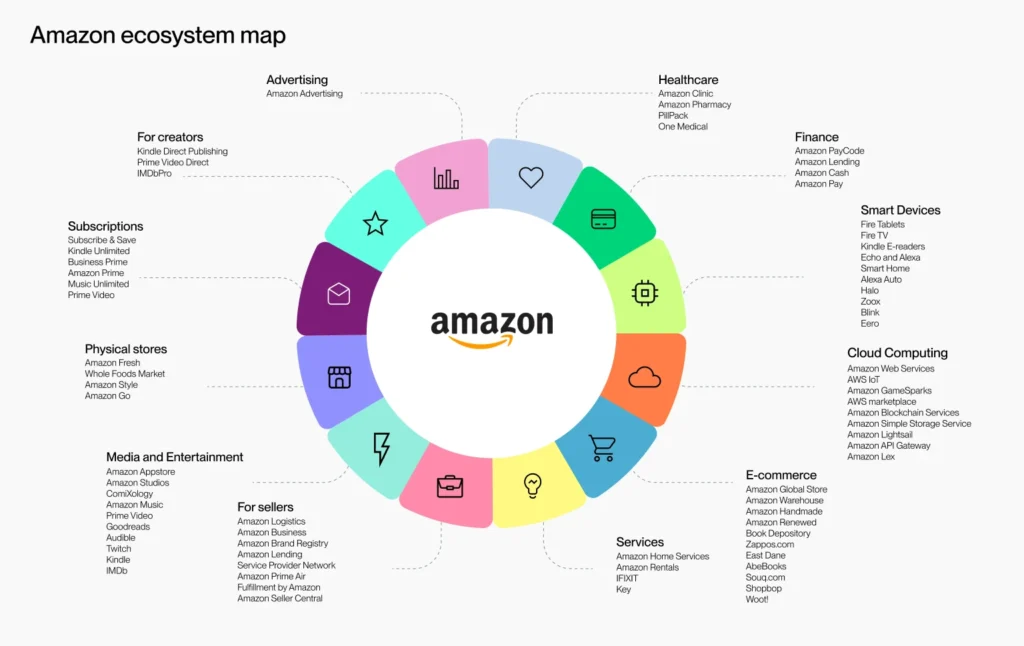
Amazon’s business segments exhibit a highly diversified revenue model, with several major lines each contributing tens to hundreds of billions of dollars per year. In the most recent period, Amazon’s total revenue reached approximately $716.9 billion, with the largest contributions coming from its core e-commerce business and platform-based services.
Here’s a breakdown of Amazon’s major segments based on the latest annual revenue contribution:
- Online Stores This segment includes direct sales of products through Amazon’s global marketplace and remains the company’s largest revenue contributor.
- Third-Party Seller Services Revenue comes from marketplace commissions, fulfillment, logistics, and services for merchants selling on the Amazon platform.
- Amazon Web Services (AWS) Cloud computing services are a major profit engine with higher margins than the retail segment.
- Advertising Services Revenue from search-based and display advertising on Amazon’s marketplace which has grown rapidly in recent years.
- Subscription Services Includes Amazon Prime, Prime Video, Music, and other digital subscription services.
- Physical Stores Revenue from physical retail chains such as Whole Foods, Amazon Fresh, and other offline stores.
This structure shows that Amazon is not only dependent on e-commerce, but also supported by cloud, digital advertising, and subscription services that strengthen long-term growth and diversification of revenue sources.
AMXZN Stock Performance from 1996 to 2025
Amazon’s Revenue Exponential Growth Reaches New Record 2025
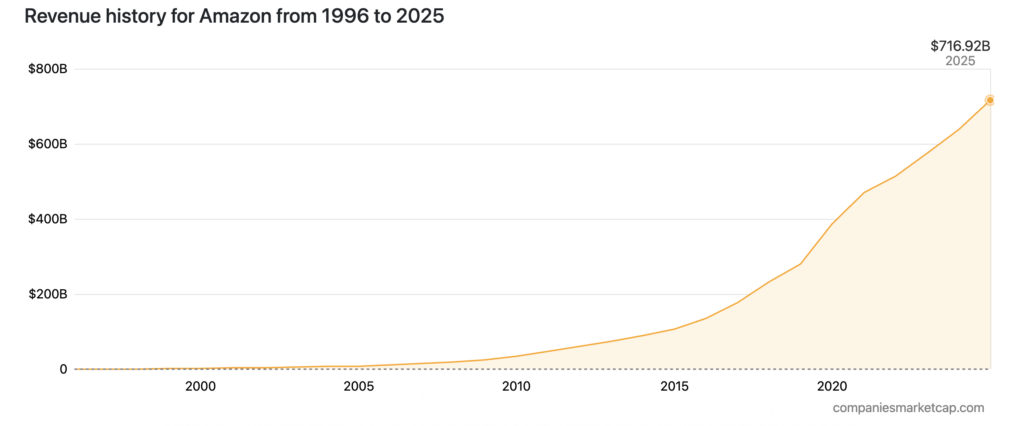
The graph shows Amazon’s revenue growth increasing very significantly from 1996 to 2025. In the late 1990s to early 2000s, revenue was still at a very low level and grew gradually.
The acceleration began after 2010, when the expansion of global e-commerce, cloud services, and business diversification drove the steep rise. The momentum continued consistently until the mid-2010s with increasingly large annual growth.
The sharpest spike occurred after 2019, when revenues increased from hundreds of billions of dollars to more than $700 billion. Based on the latest data, trailing twelve months (TTM) revenue reached $716.92 billion in 2025, up from $637.95 billion in 2024.
Amazon Revenue Data by Business Segment
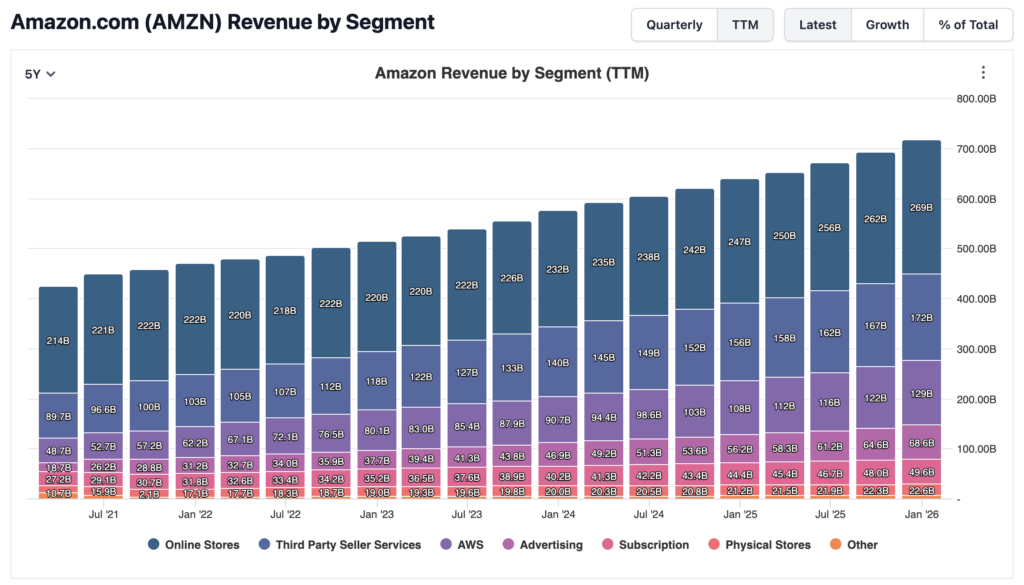
The chart shows Amazon’s revenue composition by business segment in the trailing twelve months (TTM) period over the past five years. Total revenue increased consistently from around $420 billion in 2021 to more than $700 billion in early 2026.
The Online Stores segment remained the largest contributor with revenues of approximately $269 billion, followed by Third-Party Seller Services at approximately $172 billion, and AWS at approximately $129 billion. Growth in these three key segments was the main driver of the company’s overall revenue expansion.
In addition, fast-growing segments were Advertising, which increased to approximately $68.6 billion, and Subscription Services, which reached approximately $49.6 billion. Physical Stores and other segments also made additional, albeit smaller, contributions. This structure shows that Amazon’s revenue is increasingly diversified, with a combination of e-commerce, cloud services, digital advertising, and subscription models collectively driving long-term growth.
Amazon’s P/E Volatility Towards Valuation Normalization
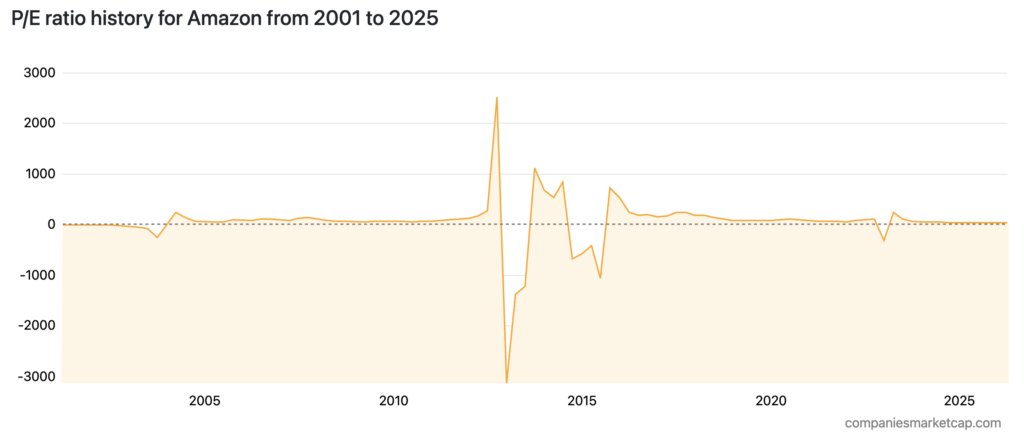
The chart shows the history of Amazon’s highly volatile price-to-earnings (P/E) ratio from 2001 to 2025. In the early 2000s, the P/E ratio moved around low to moderate levels, then increased gradually in line with the company’s growth expectations. Extreme fluctuations occurred in the 2012-2016 period when the ratio spiked very high and then fell sharply into negative territory, reflecting significant changes in net income relative to market valuations and an aggressive investment phase.
After 2017, the P/E ratio tends to be more stable although it continues to experience some short-term spikes. In the most recent period, valuations have normalized with a TTM P/E ratio of 29.19, down from 38.8 at the end of 2024. This decline indicates that earnings growth is accelerating faster than the share price, resulting in lower relative valuations compared to the previous year.
The P/E ratio (price-to-earnings ratio) is a valuation ratio that compares a company's stock price to its earnings per share (EPS) to assess how expensive or cheap a stock is relative to its earnings-generating ability.
Amazon P/S Fluctuations Reflect Changes in Revenue Growth Expectations
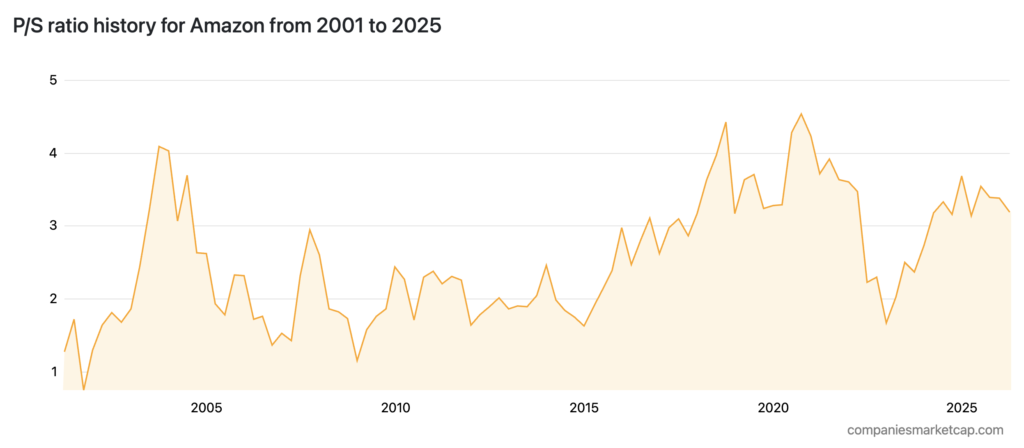
The chart shows the history of Amazon’s price-to-sales (P/S) ratio from 2001 to 2025 which moved in a moderate but fluctuating range. In the early 2000s, the P/S ratio had risen sharply to above 4 before falling back and moving in the 1-3 range for most of the 2006-2015 period. Thereafter, earnings-based valuations increased again, peaking above 4 in the 2018-2021 period, reflecting market optimism about the company’s revenue growth and business expansion.
In the most recent period, the P/S ratio experienced a correction before stabilizing in the mid-range. At the end of 2025, the P/S ratio stood at 3.38, while the latest TTM ratio increased to 5.56. This increase shows that the market valuation of Amazon’s earnings has strengthened again, indicating expectations of further earnings growth or share price increases faster than sales growth.
P/S ratio (price-to-sales ratio) is a valuation ratio that compares a company's market capitalization or share price to its total revenue to assess valuation based on the ability to generate sales.
Amazon Performance According to Experts at X
- AWS becomes Amazon’s new growth engine thanks to AI
According to Shay Boloor’s analysis on Platform X, Amazon Web Services (AWS) has evolved into one of the largest recurring revenue engines in the world. The chart shows AWS Annual Recurring Revenue (ARR) increasing consistently from around $40 billion in 2019 to around $142 billion in 2025, reflecting steady growth at a CAGR of around 23.6%.
Boloor also highlighted that the development of AI technology is now a new growth driver for AWS. The demand for cloud infrastructure for AI, generative models and large-scale computing is expected to strengthen AWS’ position as a major contributor to Amazon’s revenue, while extending the company’s long-term growth momentum.
- 3 Amazon Business Segments Surpass $100 Billion in Revenue
According to Evan’s analysis on the X platform, Amazon now has three major business segments that each generate more than $100 billion per year. The chart shows that Online Stores is still the biggest contributor with revenues of around $269.3 billion, followed by Third-Party Seller Services at around $172.2 billion, and AWS at around $128.7 billion in the latest period. These three segments are the main pillars of the company’s overall revenue growth.
In addition, the chart also shows significant contributions from other segments such as Advertising Services, Subscription Services, and Physical Stores that continue to increase every year. This diversification of revenue sources shows that Amazon is no longer dependent on a single line of business, but is instead supported by several major growth engines that strengthen the company’s long-term stability and expansion potential.
- Amazon’s Business Diversification Strengthens Long-term Growth Potential
According to LEAPTRADER’s analysis on platform X, Amazon is no longer solely dependent on its e-commerce business, but has evolved into a highly diversified business ecosystem. Besides online retail, Amazon has other key pillars such as AWS as a global cloud leader, an advertising business worth tens of billions of dollars, as well as media expansion through Prime Video, MGM, and sports broadcasting rights. On the future growth side, the company is also investing in AI through Anthropic, electric vehicles through Rivian, Zoox robotaxi, Project Kuiper satellite internet, and healthcare through One Medical.
The visuals also show the breadth of Amazon’s ecosystem, which includes smart devices, digital entertainment, financial services, logistics, and cloud-based B2B solutions. This diversification creates synergies between services while strengthening the long-term business moat. According to LEAPTRADER, the combination of various business lines and investments in future technologies puts Amazon in a strong position for long-term growth in the next decade.
AMZNX vs. AMZN Difference
The following table shows that AMZNX and Amazon common stock (AMZN) both provide exposure to Amazon’s value, but through different structures. Amazon common stock is traded in traditional capital markets, while AMZNX is in the blockchain ecosystem which is more flexible but carries additional risks. Here are the details:
| Features | Amazon Common Stock (AMZN) | Tokenized Stock Amazon (AMZNX) |
|---|---|---|
| Asset Form | Equity shares of companies traded on the stock exchange | A blockchain-based digital asset that represents Amazon’s share price |
| Market | Traditional stock exchanges such as NASDAQ | A specific cryptocurrency platform, crypto exchange, or DEX |
| Trading Hours | Follow stock exchange hours on weekdays | Generally 24/7, depending on platform and market liquidity |
| How to Access | Through a traditional stock broker or securities app | Through a crypto wallet or tokenized asset platform |
| Ownership | Represents direct share ownership | Direct shareholding without voting rights |
| Asset Holder Rights | Potentially have corporate rights such as dividends and voting, depending on the type of shares and company policy. | Generally have no voting rights, and economic rights depending on the structure of the token issuer |
| Fractional Purchase | Available with certain brokers, but not always flexible | Highly flexible and can be purchased in small quantities |
| Asset Storage | Held in a brokerage or securities custodian account | Stored in a crypto wallet on a self-custody basis or stored on the CEX platform |
| Transaction Settlement | Following the capital market settlement system | Settlement is blockchain-based making it almost instant |
| Liquidity | High as it is traded on major stock exchanges | Depending on issuer, exchange, transaction volume and market depth |
| Price Transparency | Refers to the official stock market price | Follows the price of the underlying stock, but there can be differences in price. |
| Key Regulations | Regulated by capital market authorities such as the SEC or local regulators | Depending on the jurisdiction, usually falls under the framework of digital assets, digital securities, or RWAs |
| Key Risks | Stock market risk, volatility, and firm fundamental performance | Stock market risk plus smart contract, custodial, price depression, liquidity and issuer risk |
| Dividends and Corporate Actions | Follow official company policies | Its treatment depends on the tokenization mechanism and platform policy |
| Main Uses | Suitable for long-term traditional stock investors | Suitable for crypto users who want more flexible and on-chain stock exposure |
Is AMZNX Suitable for Beginner Investors?
AMZNX focuses on capital growth strategies through investments inmid-cap companies. Its main characteristic is that it has significant growth potential, but also higher volatility thanblue-chip funds. The price movements of assets in this category tend to be more dynamic, reflecting the nature of mid-cap companies that are in a phase of rapid expansion.
Operationally, AMZNX is an actively managed fund, where the fund manager makes selective stock picks to try and outperform the market. This implies anexpense ratio that needs to be considered as part of the net return calculation. This instrument is generally chosen by investors who have an aggressive risk profile and wish to diversify their portfolio into growth sectors outside of large capitalization stocks.
Is it Safe to Buy Tokenized Stocks?
Tokenized stocks are blockchain-based digital representations of traditional stocks that allow fractional trading over 24 hours. The security of these instruments relies heavily on the platform’s regulatory compliance; without an official license from a financial authority, investors have no legal protection against operational risks or misuse of funds.
Structurally, these assets are often derivatives, so token holders may not have the voting or dividend rights of real shareholders. In addition, technical vulnerabilities in smart contracts and the absence of clear global liquidation standards make the process of asset recovery complex in the event of a hack or issuer insolvency.
Is Stock Asset Tokenization Legal in Indonesia?
Stock tokenization in Indonesia currently has a legal but limited status under the strict supervision of OJK in accordance with Law Number 4 of 2023 (P2SK Law). This regulation categorizes digital assets that resemble securities as Financial Sector Technology Innovation (ITSK), whose supervision has been transferred from Bappebti to OJK. Trading for the retail public is only allowed for platforms that have entered the Regulatory Sandbox or have a special license from the relevant authority.
Operationally, POJK Number 3 of 2024 requires every financial asset tokenization provider to go through a rigorous testing process to ensure consumer protection. Stock token offerings without an official license are considered illegal as they must comply with the transparency and ownership rights standards stipulated in Law No. 8/1995 on Capital Markets. Without compliance with these rules, these instruments have no legal operation in Indonesian jurisdiction.
Conclusion
AMZNX offers a more flexible way to gain exposure to Amazon stock movements through blockchain technology, especially for investors who want to transact on a fractional and more accessible basis. Its appeal is also supported by Amazon’s strong fundamentals, which are evident in its consistent revenue growth, diversified business segments, and the important role AWS, advertising, and platform-based services play in driving the company’s performance. However, AMZNX is still different from regular Amazon shares as it does not have the same ownership structure, regulations, investor rights, and risks, so investors need to understand its mechanics before investing.
Disclaimer: All articles from Pintu Academy are intended for educational purposes and do not constitute financial advice.
How to Buy Amazon Tokenized Stock (AMZNX) on the Pintu?
At Pintu, JPMon purchases can start as low as Rp11,000, allowing users to gain exposure to Amazon’s valuation without a large capital outlay.
In addition to AMZNX Pintu also provides various other tokenized stocks such as TLTon, MAon, and other similar assets through the Market Tokenized Stocks page, allowing users to easily access various global stocks in on-chain form.
Here’s an easy way to buy AMZNX on Pintu:
- Enter the Pintu homepage.
- Go to the Market page .
- Search and select the AMZNX crypto asset .
- Enter the amount you wish to purchase, and follow the rest of the steps.
Reference:
- Gate.io. What Is Amazon Tokenized Stock (xStock)? Understanding AMZNX and Its Investment Potential. Accessed April 7, 2026
- Phemex. What is AMZNX? Your 2025 Guide to Amazon Tokenized Stock (xStock). Accessed April 7, 2026
- BingX Academy. What Is Ondo’s Amazon Tokenized Stock (AMZNON) and How to Buy It. Accessed April 7, 2026