
In the past year, the daily trading volume of perpetual DEX surged past $100 billion driven by Hyperliquid project, Aster, and new entrants such as Lighter. Lighter is a zk-rollup-based layer 2 perpetual DEX on top of Ethereum that introduces the concept of a verifiable order book. This article will further discuss what Lighter is, how it works, key features, revenue model, tokenomics of LIT tokens, and the potential and risks you need to know.
Article Summary
- 🔗 Verifiable Fairness as a differentiator: Unlike other competitors, Lighter is building a project with a trading system where every transaction can be cryptographically verified.
- 0️⃣ Zero Fee for All Retail Traders: Lighter does not charge any fees for standard accounts (0% maker, 0% taker), making it one of the least expensive DEX perpetual platforms on the market today.
- ⚖️ Buyback Model from Revenue: A portion of the revenue from premium accounts, transfer fees, and withdrawal fees is used to automatically buyback LIT tokens through daily TWAP.
Perpetual DEX Competition 2026
To understand Lighter’s position, it is important to look at the big picture of the category first. The DEX perpetual market is experiencing significant market share growth, from only around 2.7% in 2023 to around 26% of the total global futures market volume by the end of 2025.
Along with this growth, competition between projects has also intensified. Each project comes with its own charms and advantages. Hyperliquid still dominates thanks to its mature ecosystem and loyal user base. Aster excels in cross-network integration and big-name support. On the other hand, Lighter chooses a different way by carrying out the concept of verifiable fairness, which is a transparent and verifiable trading system that cannot be manipulated by any party.
Also learn more about What is Hyperliquid at Pintu Academy

Based on the latest data from DeFiLlama, Lighter is currently the third largest DEX perpetual by 7-day volume with a total of $16.068 billion. The first position is still dominated by Hyperliquid with $52.03 billion, followed by Aster at $19.39 billion.
However, a more appropriate metric to assess trading activity is normalized volume, which is volume that has been filtered out from non-organic activity such as wash trading. On Lighter, the 24-hour normalized volume stood at around $844.67 million, lower than its reported volume of$1.135 billion. This suggests a gap of around $295 million stemming from trading activity that does not fully reflect organic transactions.
Revenue


Based on revenue data from DeFiLlama, Hyperliquid and Lighter’s revenues differ quite significantly. Hyperliquid recorded a weekly revenue of $15.2 million, about 17 times greater than Lighter which was in the range of $866 thousand. This difference is very reasonable because Hyperliquid first built user loyalty and a more mature infrastructure.
Open Interest
Data from Artemis Analytics shows that Hyperliquid still dominates the DEX perpetual sector in terms of open interest (OI). At its peak around August-September 2025, Hyperliquid’s total OI had crossed the $15 billion mark.

However, recent data shows that the combined total open interest (OI) of Hyperliquid and Lighter is currently at around $5 billion, down more than 70% from its peak. This decline illustrates the weakening market sentiment and reduced trading activity in the derivatives sector, as the risk-off attitude among investors increases.
Within this figure, Lighter’s share of OI is still much smaller than Hyperliquid’s, suggesting that Lighter is still in its early growth phase, with a depth of liquidity and market that is not yet comparable to Hyperliquid.
What Is Lighter?

Lighter is a non-custodial perpetual DEX that runs as an application-specific zk-rollup on top of the Ethereum network. The project is designed to provide a CEX-like trading experience with high speed, deep order book, fast execution, and on-chain security that cannot be manipulated by anyone, including the development team itself.
Lighter was created by Vladimir Novakovski, a former engineer at Citadel, and started running on the mainnet on October 2, 2025 after 2 years of development. In November 2025, Lighter closed $68 million in funding at a valuation of $1.5 billion backed by Founders Fund, Ribbit Capital, Haun Ventures, and Robinhood Ventures.
Lighter has 4 platform designs at its core, namely:
- Every run of the platform must be verifiable.
- Users should always have full control over their own assets.
- The system must be able to improve in terms of latency and throughput to support the growth of trading activities.
- Users should still have a safe and independent exit path, even if the Lighter is no longer operational.
How the Lighter Works
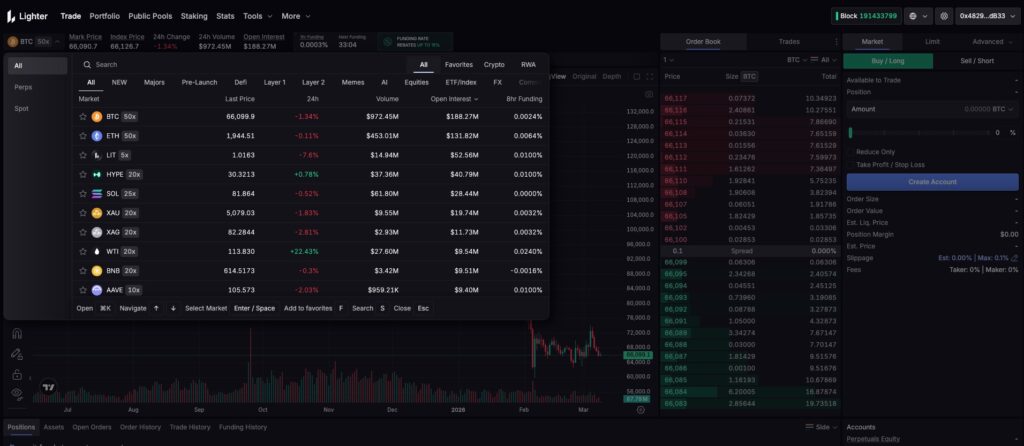
Lighter has a layered architecture that allows orders on the platform to still be executed fairly.
1. Sequencer: Automated Queuing System
The Sequencer receives all orders from users in a first-come-first-served manner and organizes them into blocks for processing. Most importantly, the Sequencer only determines the order of transactions, not matching orders. This separation of functions prevents the Sequencer from manipulating the matching results.
2. Prover: Cryptographic Proof Engine
After the Sequencer arranges the order of transactions, the Prover is tasked with proving that all orders have been executed correctly and fairly, in a first-come, first-processed manner. This proof is cryptographic, meaning that its veracity can be verified by anyone automatically.
To make this verification process more efficient, Lighter designed their own order book storage structure called Order Book Tree. Think of it like a filing cabinet that has been labeled in order of priority from the start, when you need to check, there is no need to open the shelves one by one from the beginning, just go directly to the intended archive shelf.
3. Ethereum Smart Contract
Smart contracts on Ethereum store user assets and the protocol’s canonical root state. Any state changes are only accepted after the SNARK proof is successfully verified on-chain. This means that no party can change the matching result without a valid cryptographic proof. If there is any manipulation, the proof fails immediately and the change is rejected.
4. Escape Hatch
If the Sequencer fails to process priority transactions (withdrawal of funds and closing of positions) within the specified time limit, the smart contract automatically freezes the system and users can withdraw assets directly to the Ethereum network. This mechanism ensures that there are no asset freeze scenarios including if Lighter goes bankrupt and locks users’ funds permanently.
Lighter Key Features

Lighter offers a range of product features that traders can immediately benefit from. This is what makes Lighter able to compete with other competitors not only in terms of technical innovation, but as a Perpetual DEX project that can be used easily.
1. Free of Charge for All Retail Traders
Lighter does not charge trading fees to all users who have a standard or regular account, this is an advantage offered by Lighter to attract users to trade on its platform.
For those who need extra speed like professional traders or market makers, premium accounts are available. Lighter charges around 0.002% maker / 0.02% taker for this account type, but the benefit is much faster transaction execution. Maker orders are processed almost instantly (0ms), while takers are around 150ms, while standard accounts are in the 200-300ms range.
2. Margin Management
Lighter implements a three-tier margin system that provides distance before full liquidation occurs:
- Initial Margin (IMR)
This is the minimum margin required to open a new position. If the account margin falls below this level, the user cannot add positions. However, already running positions are not closed immediately.
- Maintenance Margin (MMR)
If the account margin drops to this level, the system will start to gradually reduce positions through Immediate-or-Cancel (IOC) orders to restore the account margin ratio.
- Close-Out Margin (CMR)
If the margin continues to decline until it reaches this level, the position will be closed completely. In cases where there is insufficient liquidity in the order book, the LLP (insurance fund) will act as a final backstop to cover potential losses.
3. Real World Assets (RWA) Market
In addition to listing more than 50 crypto assets, Lighter also provides a wide selection of RWA markets such as Gold, Forex, Stocks with various leverage ranging from 2 to 50x. However, because these RWA market prices are only available on weekdays, outside of that trading enters a reduce-only mode. This means that users can only close positions and cannot open new ones.
4. Public Pools
Public Pools is a feature that allows users to delegate capital to a selection of trading operators. The trading operator uses the capital from the pool which will then be used by the trading operator to open positions. When profitable, the profit is shared among all depositors after deducting operator fees. Conversely, in the event of a loss, the loss is also shared proportionally.
5. Fair Price Marking
The mark price is the reference price used by the Lighter to calculate margin and determine when a position needs to be liquidated. So that this figure cannot be manipulated by one particular party, Lighter calculates it from three sources at once.
- Execution price in Lighter’s own order book.
- Median prices of several large CEXs for comparison.
- Restricted movement of third-party oracle data (Stork).
These three sources are combined, so that if one of the prices from these sources suddenly jumps unnaturally, the other two sources will hold it back.
Revenue Model: How Lighter Generates Profits
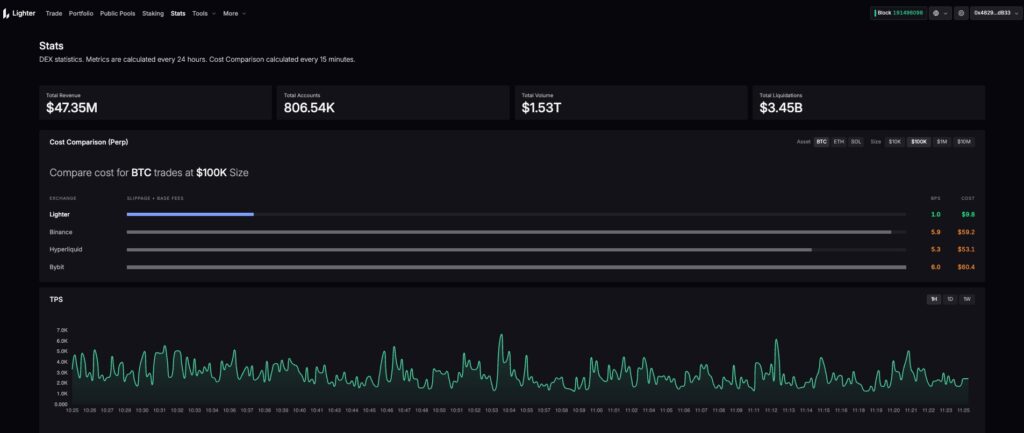
Although Lighter features zero fees for retail traders, the project still makes a profit, just not from the fees for the standard account. Here are Lighter’s sources of revenue:
- Maker and taker fees from premium accounts.
- Transfer fees.
- Withdrawal fees.
The incoming revenue is then allocated in 2 directions. Part of it is rotated back to fund ecosystem growth, partnerships, and feature development. Another portion is used to buyback LIT tokens in the market using the daily TWAP mechanism. This buyback mechanism is carried out automatically as long as the platform generates revenue. The greater the volume and activity on Lighter, the greater the buyback of LIT tokens.
Tokenomics Token LIT

LIT (Lighter Infrastructure Token) is a Lighter ecosystem token launched on December 30, 2025. The total supply is set at 1 billion tokens, with no additional inflation. The following is the token allocation distribution based on data from DropsTab:

- Team – 26%: Locked in for 1 year (cliff), then released gradually through linear vesting over 36 months.
- Ecosystem – 25%: Allocated to ecosystem development, with a vesting schedule yet to be announced.
- Airdrop – 25%: The entire allocation is released during the TGE (Token Generation Event).
- Investors – 24%: Following the cliff scheme followed by linear vesting over 36 months.
At the time of TGE, only about 25% of the total supply was circulating in the market, mainly through airdrop distribution to participants of the Lighter Season 1 and Season 2 programs. Meanwhile, around 75% of the supply was still locked and would be released gradually according to each allocation’s vesting schedule.
Uses of LIT Token
Here’s what the LIT token is used for in the Lighter ecosystem:
- Staking for LLP access: LIT token holders who stake will gain access to the LLP pool. The applicable ratio is 1 LIT staked gives access to deposit up to 10 USDC into the LLP. Currently, APR staking is still being bootstrapped using the revenue platform.
- Discounted transaction fees: LIT token stakers also have the potential to get discounts on transaction fees through the premium account feature which is currently under development.
Lighter Potential and Risks
Like any crypto project, Lighter holds both exciting potential and risks that cannot be ignored. Understanding both is a critical step investors need to take before making any decisions.
Lighter Potential
- Zero fees to attract traders
The zero-fee model for retail traders is Lighter’s built-in program design that gives it an edge over other platforms that still charge maker/taker fees. - LIT Buyback
Fee revenue is used to purchase LIT tokens from the market on a regular basis via daily TWAP. - Diversification through RWA marketplaces
The RWA marketplace option opens up new user segments that other platforms cannot serve. - Unlike other DEX perpetual projects that are competing to build their own blockchain, Lighter is built on the Ethereum network as its basic infrastructure. This way, Lighter has the potential to be more easily integrated with the mature DeFi ecosystem on the Ethereum network.
Lighter Risk
- Revenue still lags behind competitors
Lighter’s annualized revenue currently stands at around $51 million, far below Hyperliquid’s $647 million. Since LIT’s token buyback mechanism is directly dependent on the platform’s revenue, revenue growth is important to determine how much impact it will have on LIT’s token buyback. - Selling pressure from unlock schedule
Around 50% of the total supply, team allocations and investors only start entering the market after the cliff ends at the end of 2026. This could potentially cause significant selling pressure. - Sequencer is still centralized
Currently, Lighter’s sequencer is still controlled by their team. While the risk has been partially limited through smart contracts and escape hatch mechanisms, it still represents a single point of trust in the operator. The plan to decentralize the sequencer itself is still on the roadmap and has yet to be realized. - Competition is dynamic
The DEX perpetual landscape can change in a matter of months. New platforms are constantly emerging, so no position is truly safe in the long run if it doesn’t have significant traction.
How to Invest in Crypto in Pintu
After learning about Lighter, you can start investing in LIT tokens and more directly through Pintu. In addition, on Pintu Pro Web, you can also directly trade Futures!
- Create a Pintu account and follow the process of verifying your identity to start trading.
- On the homepage, click the deposit button and top up your Pintu balance using your preferred payment method.
- Go to the market page and search for your favorite asset!
- Click buy and fill in the amount you want.
- Now you have crypto assets!
Download Pintu crypto app on Play Store and App Store! Your safety is guaranteed because Pintu is regulated and supervised by Bappebti and Kominfo.
Disclaimer: All information presented in this article has been prepared for general educational and informational purposes. This content is not intended as investment advice, recommendations, solicitation to buy or sell certain crypto assets, nor the basis for financial decision making. Any investment decision is entirely the responsibility of the reader, taking into account their financial condition, investment objectives, and risk tolerance.
Conclusion
Lighter is an ambitious project in the DEX perpetual sector that offers fast, fair and verifiable trade execution. The zk rollup infrastructure, zero fees for retail traders, and automatic buyback mechanism are the main attractions. However, Lighter is still in its early phases so it’s worth keeping an eye out before considering investing in LIT tokens or trying out the platform.
Reference
- Lighter Whitepaper, “Lighter Protocol: Order Book Matching and Liquidations with Transparent and Verifiable Computation“, Lighter, accessed on March 4, 2026.
- Lighter documentation, “Introduction“, Lighter, accessed on March 4, 2026.
- Backpack, “What Is Lighter?“, Backpack, accessed March 5, 2026.
- Dora Nada, “The Perp DEX Wars of 2026: How Decentralized Derivatives Captured 26% of the Futures Market“, blockeden.xyz, accessed on March 5, 2026.
- Naga Avan-Nomayo, “Lighter raises $68 million at a $1.5 billion valuation as VC bets flood back into perp DEX infrastructure: report“, theblock.co, accessed on March 5, 2026.