
Capitulation and price bottoms are often one of the key points of reference in identifying the final phase of a cyclical market decline. In many cases, extreme selling pressure due to mass panic occurs close to the market bottom phase .This article will discuss what capitulation is in crypto, examples of capitulation, causes of capitulation, how to identify capitulation, its relationship with price lows, and entry strategies on capitulation.
Article Summary
- 💡 Capitulation in Crypto: An emotional state that drives investors to sell assets, the impact of which can have a domino effect triggered by major events.
- 🔎 Example of Capitulation: In the 2020 pandemic, Bitcoin fell by around -60% due to a shift in liquidity to safer assets. Meanwhile, negative sentiment towards certain projects such as Solana has also triggered a drop of more than -95% in a bear market phase.
- 📈 Capitulation and Market Bottom: A gradual shift in sentiment from pessimism to optimism, often an indication that asset prices are nearing a bottom phase.
- ⛓️ Market uncertainty, bear market phases, market psychology, and weak asset fundamentals can all be causes for capitulation.
What is Capitulation in Crypto?
Capitulation in crypto is a condition in which investors are forced to massively sell assets at a loss, due to a loss of faith in the potential for price recovery. This phenomenon is generally triggered by psychological pressure or market panic. Capitulation is a form of emotional psychological response by ignoring all kinds of common sense in order to exit the market.
At first glance, the price decline in the capitulation phase appears similar to the correction phase. However, a correction phase is a relatively natural price drop as part of market dynamics, whereas capitulation reflects a phase of panic that prompts aggressive and no longer rational selling.
Capitulation in crypto markets can be seen as a form of “natural selection” for investors, as it tests their confidence in the assets they hold. In this phase, prices tend to fall sustainably with no certainty of a bottom, creating higher psychological pressure if the asset is held continuously.
Investors who exit positions because they use stop losses are not the same as investors who capitulate even though they both realize losses. Stop loss is a mechanism to minimize losses according to the investor’s risk management, while capitulation is more driven by emotional actions.
Example of Capitulation in Crypto
Solana FUD 2021
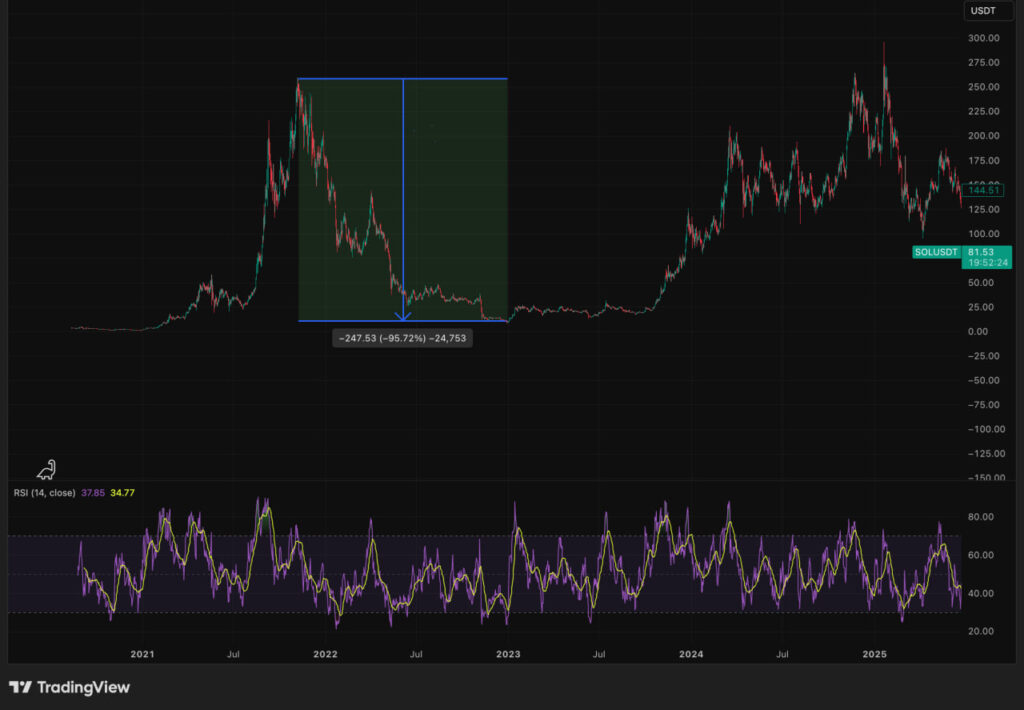
For example, an investor buys Solana at $250, and then the price drops by 30%. Under these conditions, he has several options: make additional accumulations, wait for a recovery to the entry price, or realize losses.
The decision to sell amidst strong market pressure due to a loss of faith in the potential recovery is what is referred to as capitulation, especially if accompanied by panic and emotional selling.
Usually after the capitulation phase, the asset price often goes sideways or flat until it recovers. For example, Solana fell from $250 to $10 from November 2021 to December 2022, a correction of more than 95% due to FUD, then the price went sideways for almost a year and recovered to $250 in November 2024.
COVID-19 Market Crash
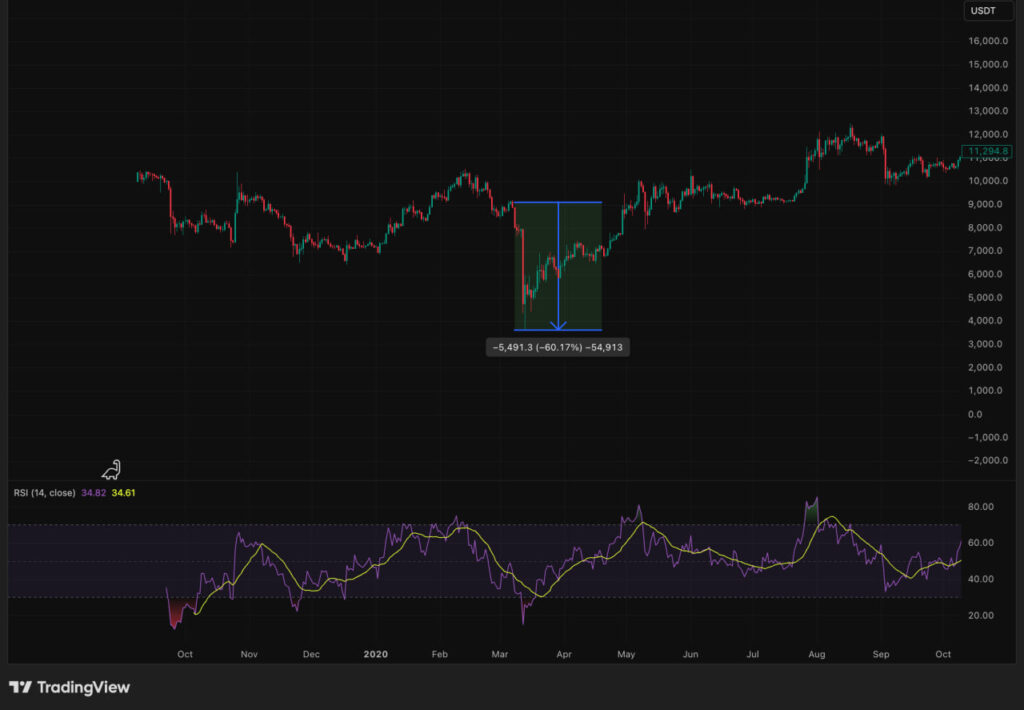
In March 2020, the COVID-19 pandemic hit almost the entire world and triggered a huge sell-off in the financial markets. This affected both stock and crypto markets, with BTC plummeting around -60.17% from $9,100 to $3,650 in less than a week. This sharp fall is one example of the capitulation phase in the crypto market during that period.
Causes of Capitulation in Crypto
Price movements triggered by capitulation are generally characterized by sharp declines with high volume and massive selling pressure. While it is difficult to predict the exact signs of capitulation, the triggering factors can be identified through the following conditions:
1. Market Uncertainty
Macroeconomic uncertainty, geopolitical tensions or other major events can trigger a shift in sentiment to risk-off. Under these conditions, investors tend to reassess their positions as the risk-reward ratio and returns are no longer considered worth it. It is this loss of confidence that can lead to capitulation.
2. Bear Market Phase
Capitulation often occurs in bear market phases, which are periods when the majority of assets have experienced significant declines over a relatively long period of time. Historically, in Bitcoin price movements, the capitulation phase often occurs after a strong rally followed by a sharp correction. Investors who entered at high prices are more prone to panic, especially if the decline is amplified by large liquidations and institutional selling pressure.
3. Market Psychology
A key element of capitulation is emotional distress due to the fear that prices will fall further. When investors can no longer tolerate volatility, selling decisions are often made in a less rational manner.
Some approaches that can help manage risk include:
- Implement risk management and avoid excessive asset exposure.
- Calculate the risk-reward ratio before opening a position.
- Avoid decisions driven by Fear of Missing Out (FOMO) and consider market momentum and structure.
- Keep a trading journal for strategy evaluation and consistency.
4. Weak Asset Fundamentals
Price increases in assets that are not supported by strong fundamentals can also trigger capitulation. Investors who enter solely due to FOMO and speculation tend to be more prone to selling when prices begin to correct.
How to Identify Capitulation
Capitulation in the crypto market can be identified through analyzing the price structure and supporting indicators. Some commonly used methods include:
- Market cycle analysis. Movements from highs to sharp declines often reflect changes in the psychology of market participants. Patterns on the price chart represent the transition from optimism to panic, which can be observed through the trend structure and trading volume.
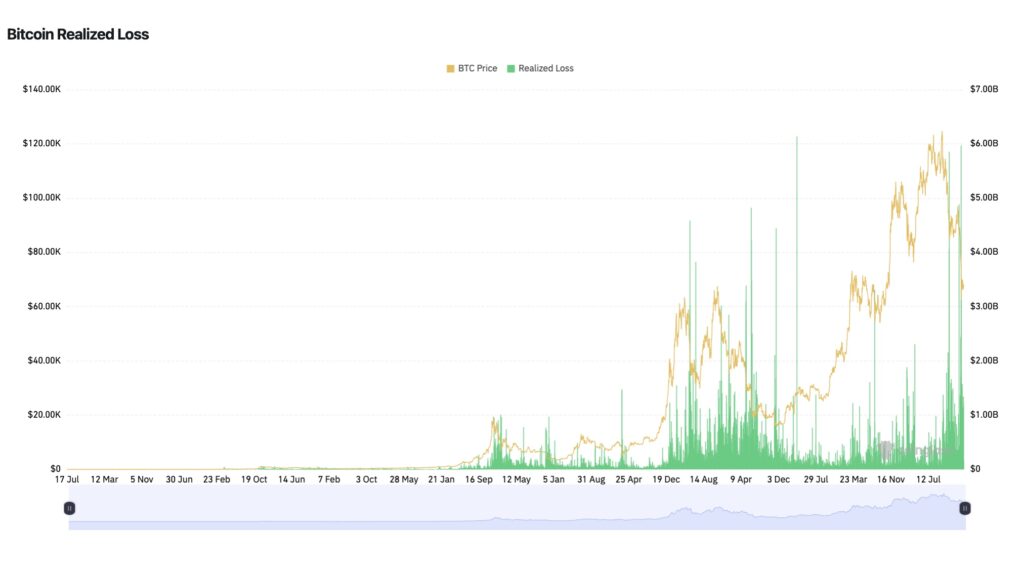
- On-chain indicators. One frequently used metric is Bitcoin Realized Loss, which measures the total realized loss based on the price at which BTC last changed hands. A significant spike in this metric could indicate extreme selling pressure synonymous with a capitulation phase. Additionally, the RSI (Relative Strength Index) indicator is also commonly used to gauge how extreme the buying and selling of an asset is. If the RSI is below 30, it could be a sign of extreme selling.
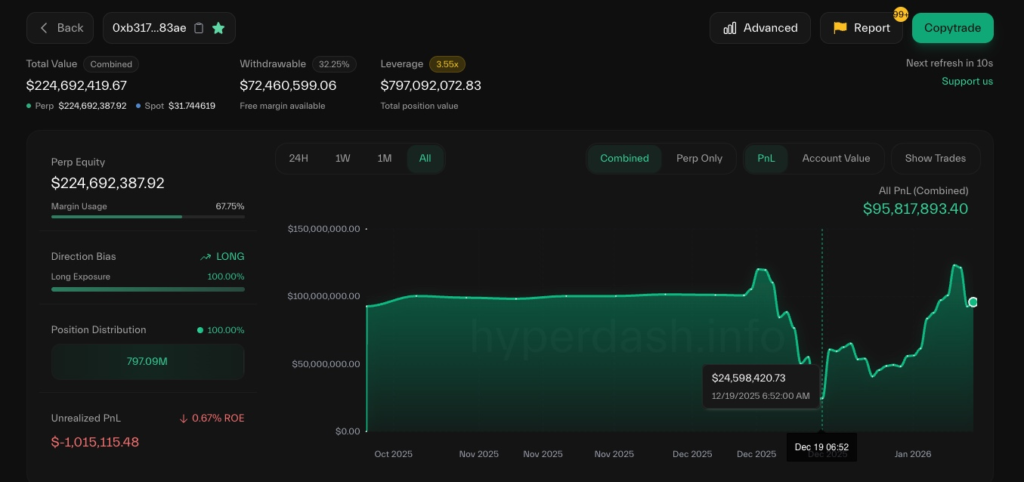
- Smart moneymovement. In extreme bear phases, the presence of accumulation by whales or large capitalized investors can be an indication that selling pressure is starting to be responded to as an opportunity by smart money. This increased buying activity from smart money often signals a transitional phase from capitulation towards potential price bottom formation.
Also learn about smart money to find out how it affects crypto assets: What is smart money in crypto and how to track it - Pintu Academy
Relationship between Capitulation and Crypto Market Bottom
Capitulation often coincides with a bottoming phase, as extreme selling pressure is often responded to with a fairly strong price bounce. However, capitulation does not necessarily mark a definitive bottom, but is more accurately understood as an indication that selling pressure has reached an extreme downward phase.
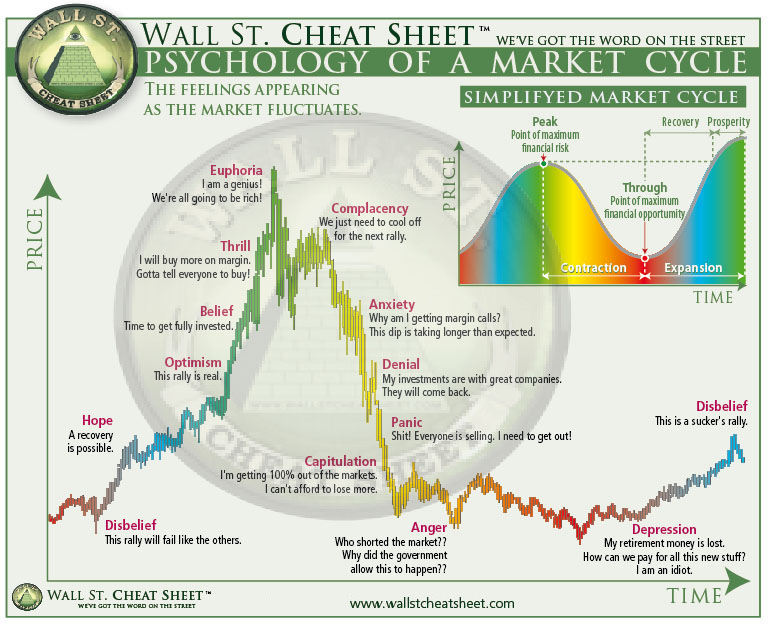
Both stock and crypto markets generally move in cycles consisting of four main phases:
- Accumulation
- Markup
- Distribution
- Markdown
In the accumulation phase, sentiment is still filled with disbelief in the potential for recovery. The bull phase is characterized by optimism to euphoria. Distribution occurs when large players begin to offload assets amid public confidence that the uptrend will continue. The decline phase often ends in capitulation, when panic triggers a massive sell-off.
Capitulation often coincides with the price bottom formation phase because selling pressure is so high, accompanied by increased volume. However, this does not necessarily mark a bottom, but rather indicates that supply in the market is beginning to be distributed. The timing and depth of these phases remains dependent on liquidity conditions and macro or fundamental sentiment.
Entry Strategy on Capitulation
After knowing the causes and ways to identify capitulation, the capitulation phase can be one of the best times to accumulate or buy assets at the lowest price or buy the dip. Here’s how to best utilize capitulation to get into the market:
1.Dollar Cost Averaging (DCA)
In practice, some investors respond to extreme downside volatility through the DCA strategy, which involves making gradual purchases at specific intervals. This approach helps reduce the risk of errors in determining entry points and does not rely on the ability to predict market timing.
2. Position Sizing
Determining the right position sizing can help limit potential losses if prices continue to fall. When combined with the DCA strategy, position sizing becomes an important component in maintaining portfolio stability and managing risk. For example:
| Capital | Capital Allocation (20%) | BTC Entry Price | Market Fall |
| 100 USDT | 20 USDT | $70.000 | 0% |
| 80 USDT | 16 USDT | $59.500 | 15% |
| 64 USDT | 12.8 USDT | $50.575 | -27,75% |
| 51.2 USDT | 10.24 USDT | $42.989 | -38,59% |
| 40.96 USDT | 8.19 USDT | $36.541 | -47,80% |
3. Waiting for Technical Confirmation
Beyond gradual accumulation, some participants await confirmed reversals, rising rebound volume, higher lows, or RSI recovering above 30.
Disclaimer: All information presented in this article has been prepared for general educational and informational purposes. This content is not intended as investment advice, recommendations, solicitation to buy or sell certain crypto assets, nor the basis for financial decision making. Any investment decision is entirely the responsibility of the reader, taking into account their financial condition, investment objectives, and risk tolerance.
Conclusion
Fundamentally, there is no indicator that can confirm a capitulation with 100% accuracy. Each market cycle has different characteristics, triggers and downturn intensity. However, by understanding the patterns, market psychology, and supporting indicators, investors can improve their preparedness for extreme selling phases and minimize the risk of emotional capitulation.
Reference
- CFI Team, “Capitulation“, Corporate Finance Institute, accessed on February 23, 2026.
- James Chen, “Capitulation: What It Is in Finance and Investing, With Examples“, Investopedia, accessed February 23, 2026.