
The crypto market is currently showing interesting dynamics. On the one hand, the price movement looks rather flat and has no clear direction yet. But on the other hand, there are early signals indicating that the market may be building the foundation for the next big move. The combination of neutral market sentiment, the influx of institutional funds, and technical structures that are still in the consolidation phase are the main points to note in this period.
Article Summary
- BTC, ETH, and SOL Analysis: Bitcoin (BTC) and Solana (SOL) prices are currently in a consolidation phase, although their movements are still holding at crucial support areas that determine the direction of the next trend. Meanwhile, Ethereum (ETH) has been stuck at the key resistance area several times, but has been able to keep its position above the support level, showing the potential for further movement in case of a breakout.
- Market Sentiment Tends to Be Neutral: The crypto market has entered another consolidation phase amid rising geopolitical uncertainty, especially after Iran closed the Strait of Hormuz again on April 18. However, the sentiment index is still in the neutral range, around the 49 level.
- Surge in Institutional Fund Flows: On April 17, there was a significant increase in Bitcoin ETF inflows, reflecting the start of accumulation by institutional investors, even a day before the closure of the Strait of Hormuz.
Technical Analysis of Bitcoin, Ethereum, and Solana April 20, 2026
Bitcoin (BTC)
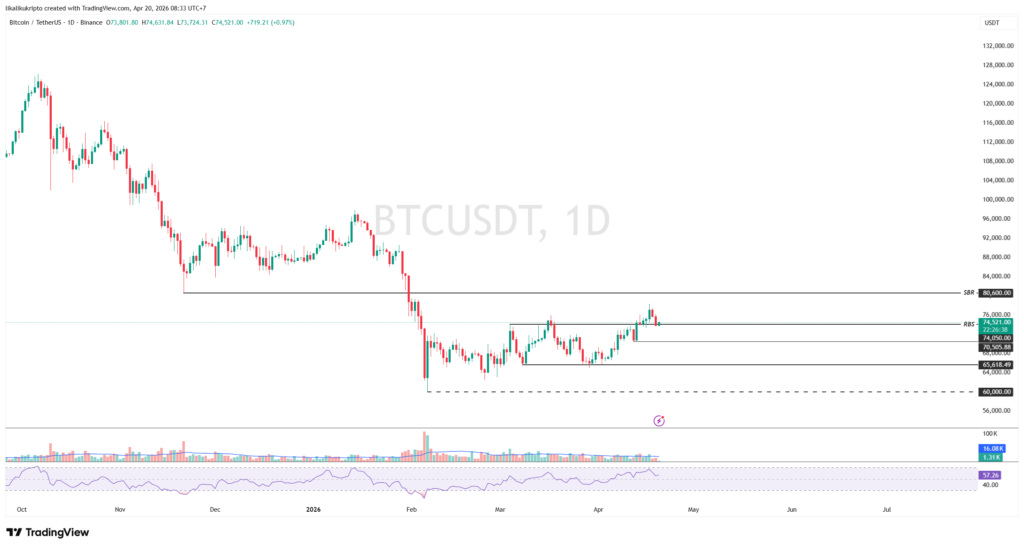
As a major asset in the crypto market, Bitcoin is currently in a very critical phase. The price is moving around the $74,000 area, which is now acting as important support (RBS).
As long as prices are able to stay above this level, the potential to continue rising remains open, with the next target in the $80,600 area being strong resistance.
However, if the price fails to hold and drops below the support, then the risk of a correction towards the $70,000 area will reopen. Overall, Bitcoin is currently still in a consolidation phase with a mild bullish bias, as long as support is maintained.
Ethereum (ETH)
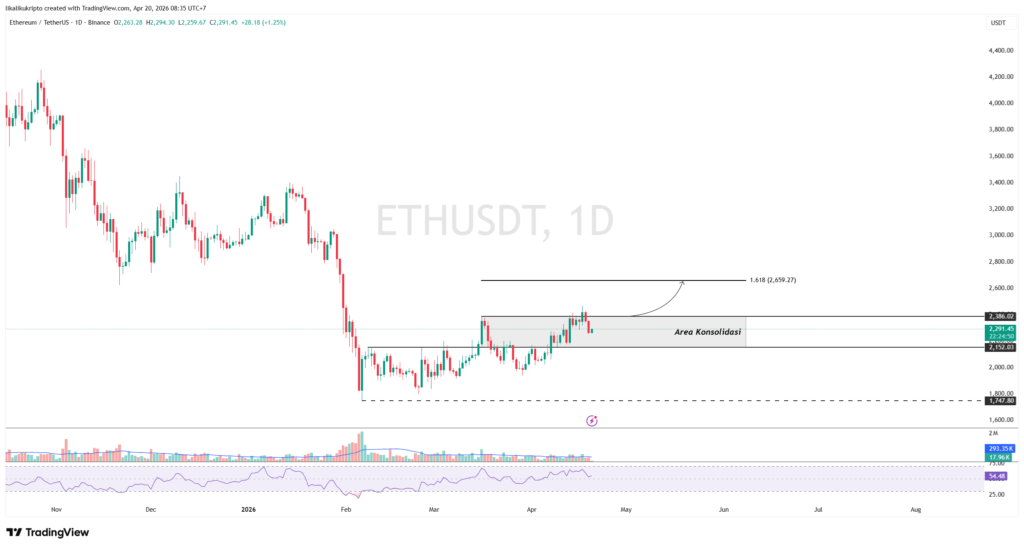
Ethereum is showing a similar pattern, with price movements stuck in a fairly clear range between $2,152 to $2,386.
The resistance area at $2,386 has held the upside several times, signaling a strong selling pressure at that level. On the other hand, the support at $2,152 has managed to keep the price from falling further.
This reflects the balance phase between buyers and sellers, where the market is “gathering energy” before determining the next direction. A breakout above $2,386 would unlock upside potential towards the $2,659 area, while a breakdown below support would signal weakness.
Solana (SOL)
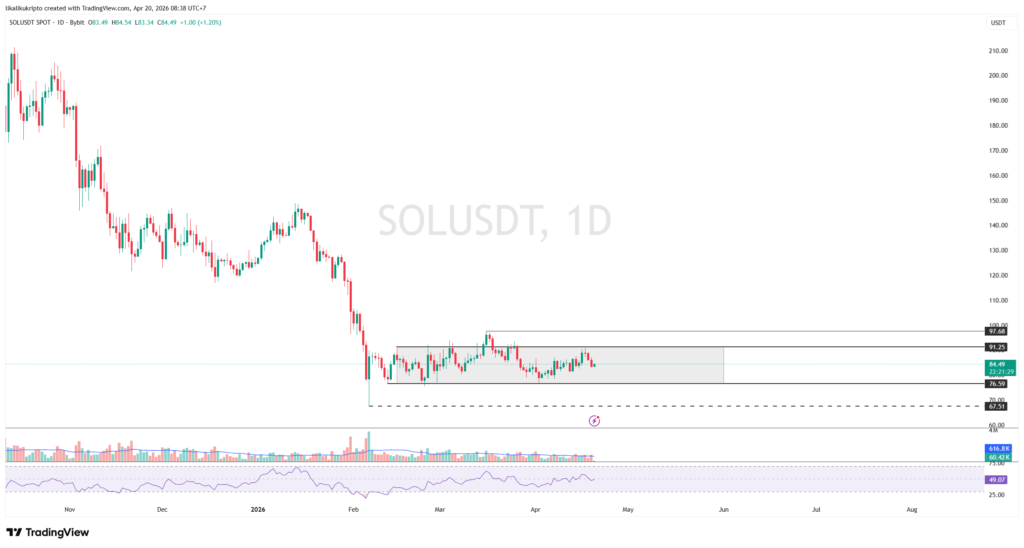
Solana, as an asset with higher volatility, is also currently in a fairly clear consolidation phase, in the range of $76.59 to $91.25.
This sideways movement occurs after a previous sharp drop, which is usually followed by a recovery phase and price stabilization.
Interestingly, volatility starts to decrease and the price range gets tighter. In technical analysis, this is often referred to as a compression phase, which usually precedes a big move.
If the price manages to breakout above $91.25, then the upside potential towards $97 to $100 is wide open. Conversely, a breakdown below support will open the risk of further correction.
Market Sentiment: Stable, Yet Not Optimistic
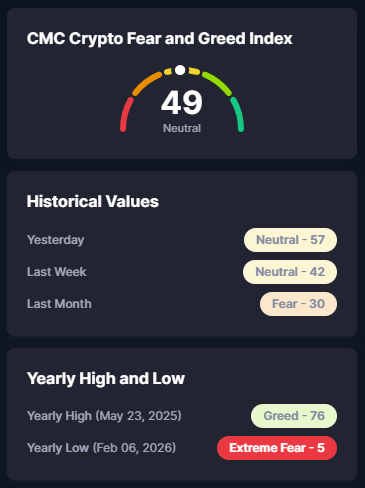
Based on the Fear & Greed Index indicator, the market is currently at 49 (Neutral). This figure reflects the balance between fear and optimism among market participants along with the re-closing of the Strait of Hormuz by Iran on April 18, according to a BBC report.
The closure of the Strait of Hormuz casts a shadow over the fear of a global oil crisis that could potentially have many repercussions.
If you look at previous movements, market sentiment is actually showing improvement:
- From level 30 (Fear) last month.
- It rose to 42 (near neutral) last week.
- It is now at 49 (Neutral).
However, the market has not yet entered the “greed” or euphoria phase. This means that retail investors still tend to be cautious and not fully confident to enter aggressively.
In many market cycles, these conditions often occur in the early phases before a major trend is established. In other words, the market isn’t crowded yet and that’s what makes it interesting.
Institutional Fund Flows: Smart Money Starts to Enter
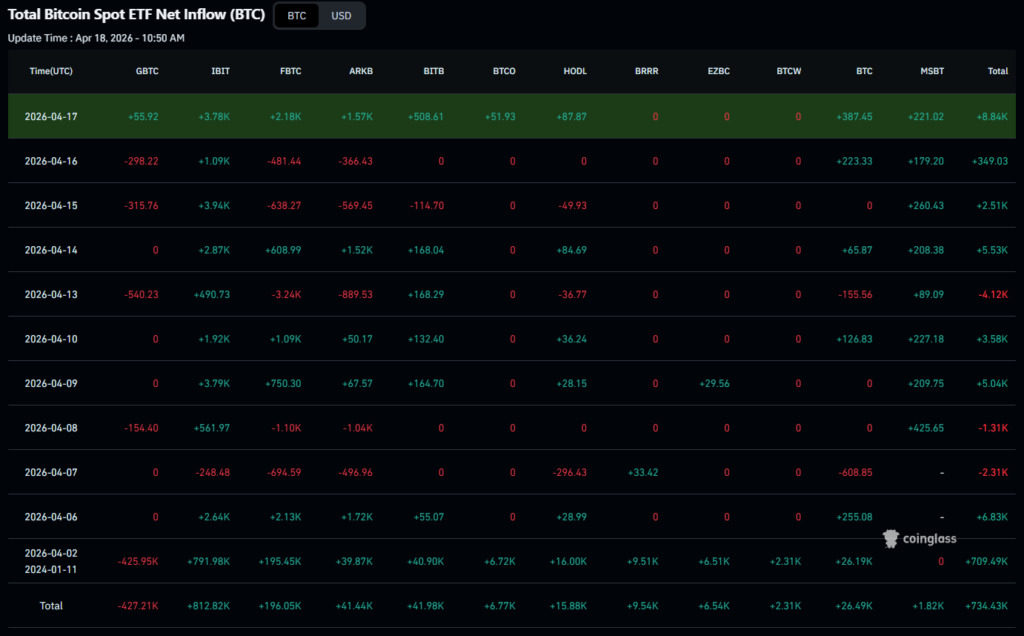
One of the most important indicators at the moment comes from the Bitcoin Spot ETF Net Flow, which shows a stronginflow of funds in recent days.
After experiencing outflows, the latest data shows that:
- The majority of days in the past week were dominated by inflows.
- There was a significant spike on April 17.
This phenomenon indicates that institutional investors are starting to come back into the market. Interestingly, while some ETFs like GBTC are still experiencing outflows, the money is not actually leaving the crypto market, but rather moving to other ETFs like IBIT and FBTC. This means that it is not an “exit”, but rather a rotation and repositioning. This is often a signal that smartmoney is gradually accumulating, even when the general market is still “quiet”.
Conclusion
The analysis above shows that market sentiment remains neutral, although the re-closing of the Strait of Hormuz has raised concerns about its potential impact going forward. On the other hand, institutional fund flows through ETFs on April 17 saw a surge, while price movements tend to be in a consolidation phase. This is not a euphoric phase, but one that is often the initial foundation before a major trend is established. In other words, the current market may not be appealing to many, but this is where opportunities begin to emerge.
Disclaimer: This article was created by Volubit. All information presented in this article has been prepared for general educational and informational purposes. This content is not intended as investment advice, recommendations, solicitation to buy or sell certain crypto assets, nor the basis for financial decision making. Any investment decision is entirely the responsibility of the reader, taking into account their financial condition, investment objectives, and risk tolerance.