Asset tokenization is the digital representation of real assets (RWAs) that are converted into tokens on a blockchain network. The asset tokenization sector has seen significant growth in the last two years. Large institutional players, cryptocurrency projects, as well as trading platforms are racing to open up access to tokenized assets to cryptocurrency investors. So, what is asset tokenization? How does it work and is asset tokenization safe? This Pintu Academy article will explain it in detail.
Article Summary
- Asset tokenization is the digital representation of real assets (RWAs) issued as tokens on top of a blockchain network. The process of moving real assets to the blockchain is called tokenization.
- Tokenized assets can be traded more flexibly and freely than traditional assets because they are in the form of cryptocurrencies. Tokenized assets can be accessed globally and purchased fractionally at almost instant speed. On Pintu, investors can buy tokenized stock and commodity assets starting from as low as IDR 11,000.
- Types of Assets that Can be Tokenized are the tokenization of real assets (RWAs) such as stocks, bonds, property, and commodity assets. Of these, the most popular asset tokenization today is stock and commodity tokenization.
- There are three risks of asset tokenization: legality risk, smart contract risk, and liquidity risk from the secondary market. However, the advantages of asset tokenization cannot be underestimated. Asset tokenization opens access to markets that are usually difficult to access and require high capital.
- The future of asset tokenization is bright. Although still in the early stages of adoption, data from DeFiLlama and RWA.xyz shows the market capitalization of asset tokenization and RWAs has already reached $29.1 billion as of April 14, 2026. McKinsey & Company estimates the global asset tokenization market could reach $2 trillion by 2030, nearly 75 times its current size.
What is Asset Tokenization?
Asset tokenization is the digital representation of real assets (RWAs) issued as tokens over a blockchain network. The smart contract automatically enforces the rights and transfer rules of each token on the blockchain. The process of transferring real assets to the blockchain is called tokenization. Tokenized assets can be traded more flexibly and freely than traditional assets because they are in the form of crypto assets.
Each tokenized asset token represents a real-world asset with a 1:1 equivalent value. This means that 1 NVDAx token (tokenized Nvidia stock) has the same value as 1 NVDA share. With tokenization, investors and traders can buy assets fractionally, make instant trades, and access the market 24/7.
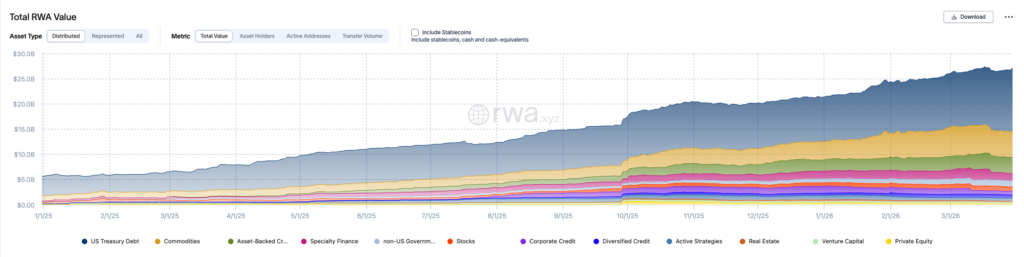
Based on data from RWA.xyz, as of April 14, 2026, the market capitalization of tokenized assets in the crypto industry has reached $29.1 billion. The two largest tokenized assets at the moment are tokenized commodities (gold, silver, and oil) and US stocks.
Why should there be asset tokenization?
As an Indonesian, there are three major drawbacks to many traditional investment assets such as US Stocks and the like:
- Access barriers. Investing in bond assets, overseas company shares, or gold often requires substantial capital, exclusive networks, or access to specific markets.
- Limited Trading Experience. Stock transactions require a long time and high capital.
- Low liquidity. Not many platforms provide high liquidity for assets like US stocks with clear transparency. What’s more, the process of trading through a broker also adds risk.
How does Asset Tokenization Work?
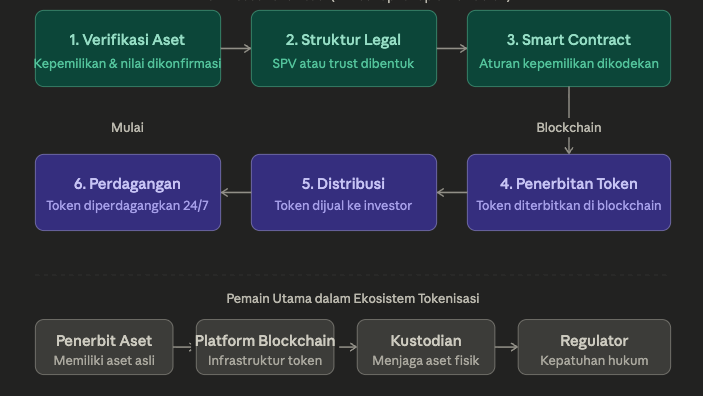
The process and workings behind Real-World Assets (RWA) tokenization is the process of bringing physical assets into the blockchain network. To ensure digital tokens have legal standing and real value in the physical world, the tokenization process relies on three main steps:
1. Asset Search and Valuation
Before any programming code is written, the process begins in the real world. Financial institutions or tokenization platforms identify assets to be tokenized, such as stocks, government bonds, or physical gold. The tokenization platform works with the financial entity to buy and sell the asset to ensure liquidity and legality.
2. Legal Process and Custodial Storage Crypto blockchain networks cannot physically store gold bullion or land titles. Therefore, these assets must be legally “wrapped” to bridge the physical and digital worlds.
- Special Purpose Vehicle (SPV): The issuing company usually creates a special legal entity, such as an SPV or Trust, whose sole purpose is to legally own the assets. The SPV also makes bulk purchases and sales and ensures the liquidity of the assets.
- Custody: The physical asset is then deposited with a regulated third-party custodian (such as a trusted bank vault for gold, or a regulated securities broker for stocks). The custodian ensures that the purchased assets are safely stored and legally recorded.
3. Smart Contracts and Distribution Once the legal framework and storage are complete, the assets are finally brought to the on-chain network. Developers write smart contracts (computer programs on the blockchain that execute commands automatically) on major blockchain networks such as Ethereum and Solana.
- TokenMinting: Smart contracts mint digital tokens that represent fractional portions purchased. For example, 1 MSFTx (Microsoft xStocks) token is equivalent to 1 share of Microsoft stock. With asset tokenization, you can buy 0.2 MSFTx which is equivalent to about $100.
- Automation of Parameters and Rules: Smart contracts are permanently programmed with strict rules (such as only allowing investors who have passed KYC verification to purchase tokens) and automated financial logic (such as distributing stock dividends or to token holders’ crypto wallets ).
Once minted, these RWA tokens are distributed to investors and can be instantly traded on crypto secondary markets globally, 24 hours a day, 7 days a week.
Tokenized Assets Types
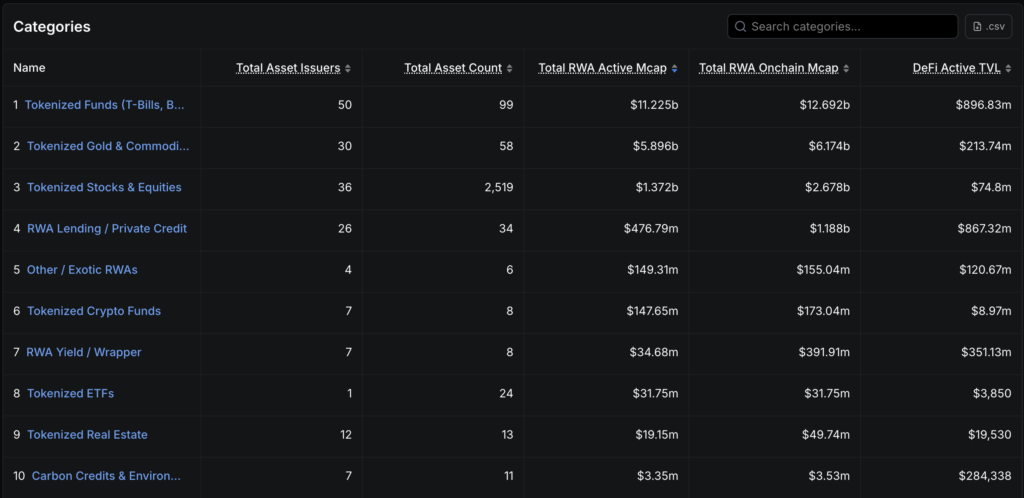
So, what are the assets that can be tokenized? Almost any asset that has economic value can be tokenized, as long as there is a legal framework that supports its ownership. Here are the types of assets that can be tokenized:
- Physical assets: commercial property, land and infrastructure.
- Financial instruments: stocks, bonds, ETFs (Exchange Traded Funds) and mutual funds.
- Commodities: gold, silver and oil.
- Private equity: pre-IPO company shares, and Venture Capital assets.
However, there are currently two most popular types of asset tokenization, namely stock tokenization and commodity tokenization.
Stock Asset Tokenization: Stock Trading with Minimal Capital
Stock asset tokenization is a digital representation of ownership of shares of a company (such as Tesla stock). Each token is a 1:1 representation of the original stock. Stock tokenization opens up access to shares of major companies to investors outside of their legal territory. For example, Indonesian investors can directly buy US stocks and ETFs, such as tokenized shares of Google or Nvidia, or the iShares 20+ Year Treasury Bond ETF.
The tokenization of stock assets also opens up fractional purchase opportunities, where investors don’t need to buy shares by the piece. So, you can buy Nvidia’s xStocks shares for as little as $50 or $100. In addition, the buying and selling of tokenized assets happens instantly and almost 24/7.
However, there are some risks for investors such as legality risks, platform risks, and security risks. Regulations related to tokenization vary in different countries and can change at any time. Currently, the leading asset tokenization platforms are Ondo Global Market and xStocks. Both are relatively new tokenization platforms. Finally, the security quality of each tokenized asset also depends on the blockchain and the writing of smart contracts.
Learn more about what stock asset tokenization is, how it works, and its advantages.
Commodity Asset Tokenization: Investing in Digital Gold, Silver, and Other Commodities
Commodity asset tokenization is the digital representation of a physical commodity held by a licensed custodian. Each token usually represents a certain weight or volume of that commodity. Two examples of commodity asset tokenization are Paxos Gold (PAXG) and Tether Gold (XAUT), which are the two largest gold tokens. So, each token represents one troy ounce of physical gold stored in licensed vaults. Investors can buy $50 worth of PAXG and own a fractional equivalent of the physical gold purchased.
Physical gold is difficult to store, insure, and move. Gold tokens provide all the benefits of gold investment without the logistics of physical storage. Gold tokens can also be shipped around the world in minutes at a very low cost.
Full trust relies on the custodian holding the physical commodities. Investors should verify that physical reserves actually exist and are regularly audited by an independent party. The risk of a custodian getting into trouble or making false claims about its physical reserves is a real risk that has occurred in the industry.
Learn about the difference between buying physical gold vs. buying digital gold and tokenization of gold assets or crypto-based gold.
Comparison of Asset Tokenization vs. Traditional Stocks and Assets
| Aspects | Traditional Assets | Asset Tokenization |
|---|---|---|
| Buy-Sell Speed | Depends on the broker, exchange, and market conditions | Near-instant (seconds) |
| Minimum Capital | High (depending on sheet price and purchase regulations) | Minimum capital (IDR 11,000 in Pintu app) |
| Trading Hours | US market trading hours | 24/7 |
| Storage | Through broker/custodian | Self-custody in crypto wallet or stored in CEX |
| Transparency | Limited | Verifiable on-chain and on tokenization platforms |
| Programability | None | Freely transferable and compatible with crypto ecosystems (such as Jupiter, Phantom, and Kamino) |
Here’s a more in-depth explanation for each aspect of the comparison above:
Buy-Sell Speed
In the conventional stock market, transactions that occur today can be completed 1-2 days later. This means that during that period, ownership is still “hanging” in the hands of the clearing house. Asset tokenization completes transactions on the blockchain in seconds, as there is no intermediary who needs to confirm the transfer of ownership.
Minimum Capital
In TradFi, you can only buy stocks per share. With tokenization, you can buy shares at a very small minimum price and buy them in token size (e.g. 0.5 tokens tokenized Amazon stock AMZNx). Investors with little capital can own a share of premium assets that were previously out of reach.
Trading Hours
Stocks are limited by trading hours. Shares of US companies can only be traded during US trading hours. With asset tokenization, investors and traders can trade almost 24 hours, 7 days a week, without restrictions. However, there are usually exceptions for some assets.
Storage
In traditional systems, if a broker or custodian goes down, investors’ assets can be affected. Asset tokenization enables self-custody where investors store tokens in their own private wallets and are not dependent on third-party business continuity.
Transparency
Traditional share ownership is stored on the broker’s internal systems, which are not publicly accessible. Tokenized asset ownership is recorded on a blockchain that is public and permanent, so anyone can verify that a token actually exists and is owned by a specific address.
Programming Ability
The programmability of blockchain is an advantage that traditional assets don’t have at all. Smart contracts allow rules to be automated: dividend distribution directly to token holders’ wallets, restrictions on transfers to investors who have not passed KYC, or restrictions on asset transfers. All without human intervention.
Advantages of Asset Tokenization
Asset tokenization is not just a digitized version of traditional assets, it is an entirely different financial infrastructure. Here are the real advantages it offers over conventional systems:
1. Unlimited Global Access
An investor in Jakarta can buy Nvidia shares, US government bonds, or physical gold from London. All these assets can be stored on a single crypto app, without the need to open an account with a foreign broker or meet high minimum capital requirements. Tokenization removes the geographical barriers that have separated retail investors from global premium assets.
In addition, the taxes associated with tokenizing stock assets are also much less than buying US stocks directly.
2. Fractionalization: Small Capital, Large Access
Berkshire Hathaway class A shares sell for more than $600,000 each. With tokenization, the same asset can be purchased for $10. This fractionalization opens up asset classes that have been out of reach for investors and traders outside the US.
3. On-Chain Transparency and Verification
Every transaction, ownership, and asset transfer data is permanent on the public blockchain. Unlike traditional brokerage systems that keep ownership data internally, anyone can verify the existence and ownership of tokens. In addition, asset tokenization platform providers such as xStocks and Ondo Global Market are also very transparent about the ownership and custody of their assets.
4. Automation Through Smart Contracts
All commands related to the sale, purchase, and dividend distribution of a stock can be programmed directly into the smart contract and run automatically. This makes tokenized assets very flexible to be set up and programmed according to the needs of the tokenization service provider.
Smart contracts and blockchain technology ensure that every purchase and sale is done quickly and easily. In addition, smart contracts also work as an automated record-keeping system that makes the data of a tokenized asset publicly accessible on the blockchain.
Asset Tokenization Risk
Like every new financial instrument, asset tokenization carries a set of risks that need to be understood before investing. Here are the main risks to be aware of:
1. Regulatory and Legality Risk
Regulatory risk is the most significant risk for many investors. The legal status of asset tokenization varies widely: some jurisdictions allow it, some restrict it, and some have no clear regulation. Fortunately, OJK has issued a regulatory framework governing asset tokenization through POJK 27/2024 and POJK 23/2025. In the US itself, asset tokenization has been permitted by the Fed, SEC, and NASDAQ. So, regulations in Indonesia clearly allow tokenized ownership of assets in the form of stocks and commodities such as gold.
2. Platform and Smart Contract Risk
Smart contracts are program code, and code can contain bugs or vulnerabilities. If the smart contracts governing the tokens are exploited by hackers, investor funds can be permanently and irreversibly lost. In addition, a tokenization platform is a business that can shut down. If the platform goes bankrupt or ceases operations, the process to redeem the assets underlying the tokens can become very complicated.
3. Secondary Market Liquidity Risk While tokenization in theory increases liquidity, the reality is that not all tokens have an active secondary market. Tokens from small projects or platforms can be very difficult to sell if there are not enough buyers in the market, leaving investors stuck in a position that cannot be liquidated at a fair price.
What is the Future of Asset Tokenization?
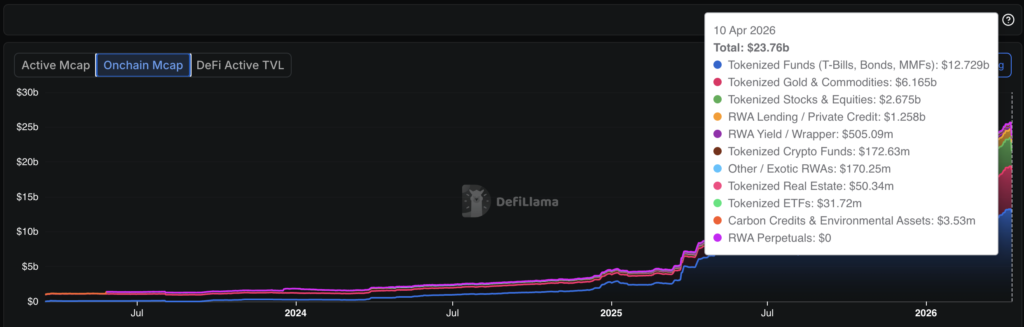
Asset tokenization is still in the early stages of adoption, but the projected growth is huge. Based on data from DeFiLlama and RWA.xyz, the market capitalization of asset tokenization and RWAs has reached $29.1 billion as of April 14, 2026. In fact, at the beginning of 2024, the tokenization sector only reached $1.8 billion (a growth of more than 1,300% in 2 years). McKinsey & Company estimates that the global asset tokenization market could reach $2 trillion by 2030, almost 75 times its current size.
Entry of Large Financial Institutions
The clearest sign of the legitimacy of asset tokenization is the entry of names like BlackRock, Franklin Templeton, JPMorgan, and Goldman Sachs into the ecosystem. BlackRock launched BUIDL in 2024, their first tokenized money market fund on the Ethereum network, and it soon became the largest tokenized fund in the market. When the world’s largest asset managers build products on top of blockchain, it’s no longer a fringe experiment of the crypto industry. It is a signal that the tokenization infrastructure is mature enough to accommodate institutional capital at scale.
In addition, a unique case of asset tokenization technology is the volume of oil trading on Hyperliquid (What is Hyperliquid?). BitWise’s CIO, Matt Hougan, explains that blockchain is able to facilitate the trading of all types of financial assets that can be done globally without any restrictions on trading hours. So, when oil trading is not accessible everywhere, traders and investors turn to the tokenization of oil assets on Hyperliquid.
Asset Tokenization as a New Financial Infrastructure
The long-term vision of asset tokenization is not just about making stocks or gold available for purchase with crypto. Asset tokenization could rebuild entire layers of the global trading and investment infrastructure, from markets that never close, to instant trade finalization, to access restricted by country regulations. If the tokenization market continues to grow, blockchain has the potential to become the platform on which the entire global financial system runs, and asset tokenization is its first entry point.
Conclusion
Asset tokenization is one of the most significant developments at the intersection of traditional finance and blockchain technology. The process of converting real-world assets into digital tokens is not just a technical innovation, but can change the way investors and traders buy assets. With tokenization, all assets can be traded 24/7 globally.
For Indonesian investors, the relevance of asset tokenization is very real. The access barriers that have separated retail investors from global assets such as US government bonds and stocks of the world’s largest technology companies can now be overcome. In one portfolio, investors can have tokenized gold, stocks, and crypto assets as well.
However, like every new financial instrument, asset tokenization does not come without risks. Risks such as smart contract hacking, custodian risk, and tokenization platform provider risk remain to be considered.
Asset tokenization is not a short-term trend. The trend of asset tokenization will only continue to grow over time. It could be the foundation of the next generation of financial infrastructure, and understanding it early on gives an edge to investors who want to be prepared for the change.
Frequently Asked Questions (FAQ)
What is asset tokenization and how does it work?
Asset tokenization is the process of converting real-world assets such as stocks, gold, or bonds into digital tokens issued on top of a blockchain network. How it works: the physical asset is held by a licensed custodian, and a smart contract prints digital tokens that represent ownership of the asset. Each token has a 1:1 value to the original asset, can be traded 24/7, and its ownership is transparently recorded on the blockchain.
How is asset tokenization different from traditional stock?
Asset tokenization differs from common stocks in three main ways: transaction speed, accessibility, and asset storage system. First, transaction speed: stocks usually take a long time to transact, whereas token transactions are completed in seconds. Second, accessibility: common stocks have minimum capital limits and trading hours, while tokens can be purchased fractionally with small capital (IDR 11,000 at Pintu) and traded 24 hours a day. Third, the asset storage system: shares are stored on behalf of the broker, while tokens can be stored on their own in a private wallet without relying on a third party.
Is asset tokenization legal in Indonesia?
OJK has issued a regulatory framework governing asset tokenization through POJK Number 27 of 2024 and POJK 23/2025. In the US alone, asset tokenization has been permitted by the Fed, SEC, and NASDAQ. So, regulations in Indonesia clearly allow tokenized ownership of assets in the form of stocks and commodities such as gold.
Is asset tokenization safe?
The security of asset tokenization depends on three layers: the security of the platform’s smart contracts, the reputation of the custodian that stores the physical assets, and the investor’s own security practices. The main risks include bugs in smart contracts, custodians not being transparent about physical backups, and the risk of losing access if the wallet’s private keys are lost. To minimize risk, choose a platform that conducts regular smart contract audits, has licensed custodians, and publishes proof of reserve reports regularly.
What is RWA in crypto?
RWAs (Real-World Assets) in crypto refer to real-world assets that have been tokenized and published on the blockchain. The most common examples of RWAs today are US Treasuries (US government debt securities), physical gold, shares of public companies, and commercial properties. RWAs are one of the fastest-growing segments in the crypto industry. The market capitalization of tokenized assets and RWAs has reached $29.1 billion as of April 14, 2026, based on data from RWA.xyz.
What are some examples of existing asset tokenization?
Some examples of asset tokenization already in operation today:
- BUIDL (BlackRock): tokenization of US Treasury-based money market funds on Ethereum.
- PAXG & XAUT: gold tokens that each represent one troy ounce of physical gold.
- xStocks: tokenization of US stocks such as Apple, Nvidia, and Microsoft that can be bought fractionally.
- Ondo Finance: a tokenization platform of US stocks such as Mastercard (MAon), Microsoft (MSFTon), and Alibaba (BABAon).
How to Buy Tokenized Assets on the Pintu Platform
On Pintu, the purchase of tokenized assets can start with a very affordable amount, starting from Rp11,000, so that users can invest without large capital. Pintu provides various tokenized assets such as TSLAX, PAXG, XAUT, AMZNx, and other similar assets through the Market Tokenized Stocks page.
Before buying tokenized assets on Pintu app, you need to do KYC and deposit money through various banks in Indonesia. With Pintu, you can own crypto assets, crypto-based digital gold, and tokenized US stock assets right in one investment app!
Here’s how to buy tokenized stock assets like Microsoft Tokenized Stock (MSFTon) on Pintu:
- Enter the Pintu homepage.
- Go to the Market page.
- Search and select the MSFTon crypto asset.
- Enter the amount you wish to purchase, and follow the rest of the steps.
Disclaimer: All articles from Pintu Academy are intended for educational purposes and do not constitute financial advice.
Reference
- Matt Hougan, “The Weekend That Changed Finance“, BitWise.
- “Revolutionizing Asset & Wealth Management“, Kineyxs by J.P. Morgan.
- “Understanding tokenized real-world assets“, MetaMask.
- Four Pillars, “2026: The Year of Tokenized Stocks“